
GW170817 established binary neutron star mergers as engines of relativistic jets and as sites of rapid neutron-capture (r-process) nucleosynthesis. I use 3D general-relativistic magnetohydrodynamic (GRMHD) simulations with neutrino transport to model compact object mergers and the multi-messenger signals they produce, to understand where the heaviest elements in our Universe are made and how matter behaves at extreme densities. I work with Prof. David Radice in the Numerical Relativity group at Penn State.
Neutrino flavor transformation in neutron star mergers
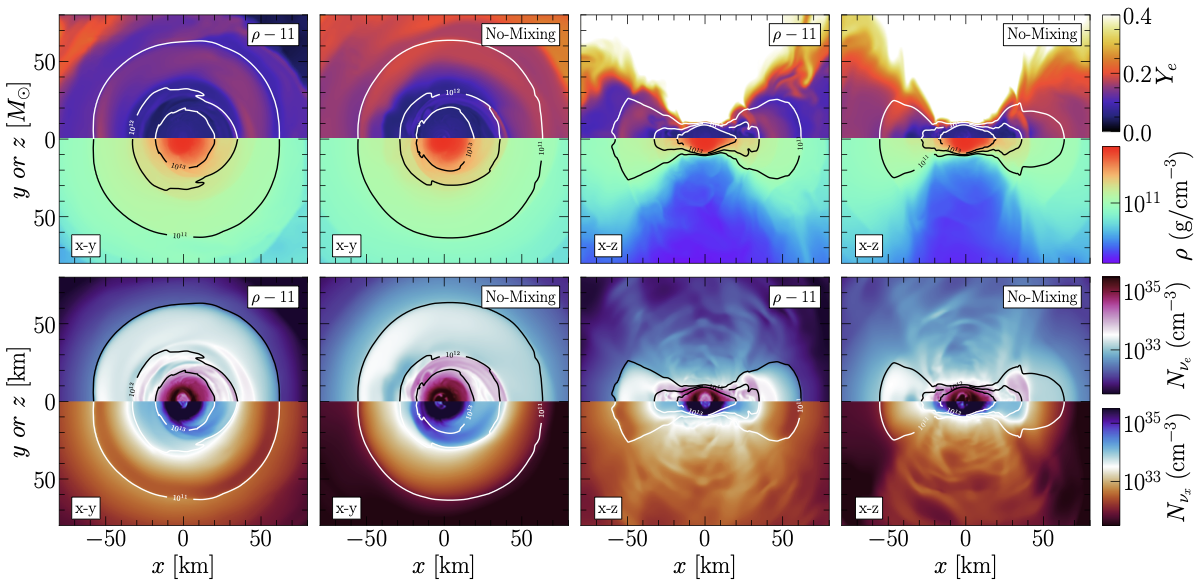
Neutrinos set the electron fraction Ye of merger outflows through their interactions with matter, and so decide both the r-process yields and the color of the kilonova. A major uncertainty has been the neglect of flavor conversions: in merger environments neutrinos can change flavor on nanosecond timescales, six orders of magnitude faster than the merger itself, which makes them very hard to include in global simulations.
I performed the first merger simulations in which neutrino flavor transformation is treated self-consistently, by coupling two-moment (M1) neutrino transport to a Bhatnagar–Gross–Krook subgrid model that represents flavor oscillation as a relaxation process. I then extended this to long- and short-lived remnants, different equilibration timescales, and different mixing treatments, carrying each case through nucleosynthesis and multi-messenger signals. Flavor conversions drive the matter toward more neutron-rich conditions, producing up to 300% more neutron-rich ejecta and boosting r-process yields by up to an order of magnitude.
- Y. Qiu, D. Radice, S. Richers, M. Bhattacharyya, Neutrino Flavor Transformation in Neutron Star Mergers, Phys. Rev. Lett. 135, 091401 (2025), Editors' Suggestion [arXiv] [DOI]
- Y. Qiu et al., Impact of Neutrino Flavor Conversions on Neutron Star Merger Dynamics, Ejecta, Nucleosynthesis, and Multi-Messenger Signals, Phys. Rev. D 112, 123039 (2025) [arXiv] [DOI]
GPU-accelerated neutrino transport and machine-learned microphysics
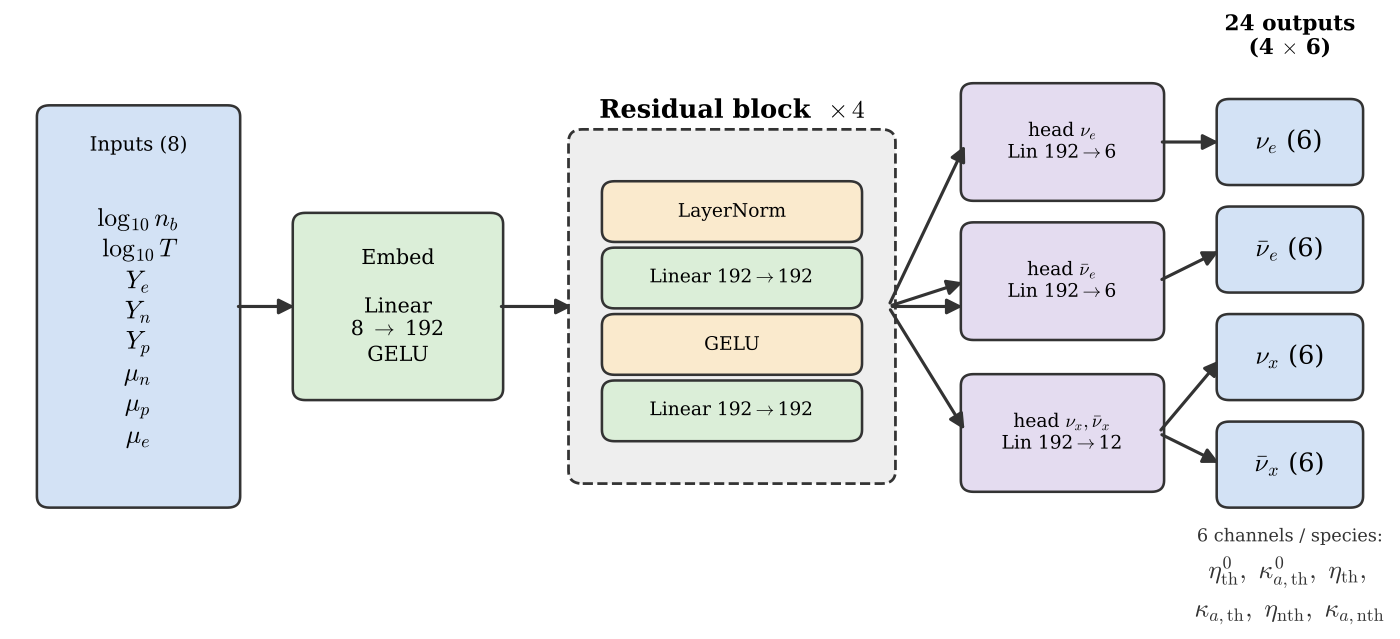
Building on its predecessor THC M1, I led the porting and development of the open-source, GPU-portable M1 neutrino transport module in AthenaK, which is now used for production merger simulations. Profiling showed that the neutrino reaction rates, supplied by the bns_nurates library, consumed about 70% of the kernel time. I therefore developed a hybrid neural-network emulator that replaces only the expensive two-dimensional reactions (pair processes, inelastic scattering, and bremsstrahlung) while keeping the cheap one-dimensional ones exact. It reproduces the rates to within a few percent and evaluates them roughly ten times faster. In a full merger simulation it recovers the remnant structure, ejecta composition, and neutrino luminosities and mean energies to within 5%, with a measured end-to-end speedup of 2.16.
With this code we are building a catalog of more than a thousand GRMHD binary neutron star and black hole–neutron star simulations with M1 transport, to study mass ejection and gravitational waves systematically. I also contribute to extending the reaction set to muon neutrinos, to machine-learned predictions of flavor mixing, and to modeling the chiral magnetic effect.
- Y. Qiu, D. Radice, R. Ferrari, A. Perego, A Hybrid Neural Network Emulator for M1 Neutrino Reaction Rates in Binary Neutron Star Merger Simulations, submitted (2026) [arXiv]
- Y. Qiu, M. Bhattacharyya, D. Radice, Performance-portable moment-based neutrino transport with AthenaK, in preparation.
Gravitational-wave modeling
Nonlinear black hole ringdowns. Using numerical-relativity binary black hole waveforms and Bayesian model selection, I showed that nonlinear ringdown models describe the early post-merger signal better than adding linear overtones, which matters for tests of general relativity with ringdowns.
- Y. Qiu, X. Jiménez Forteza, P. Mourier, Linear versus nonlinear modeling of black hole ringdowns, Phys. Rev. D 109, 064075 (2024) [arXiv] [DOI]
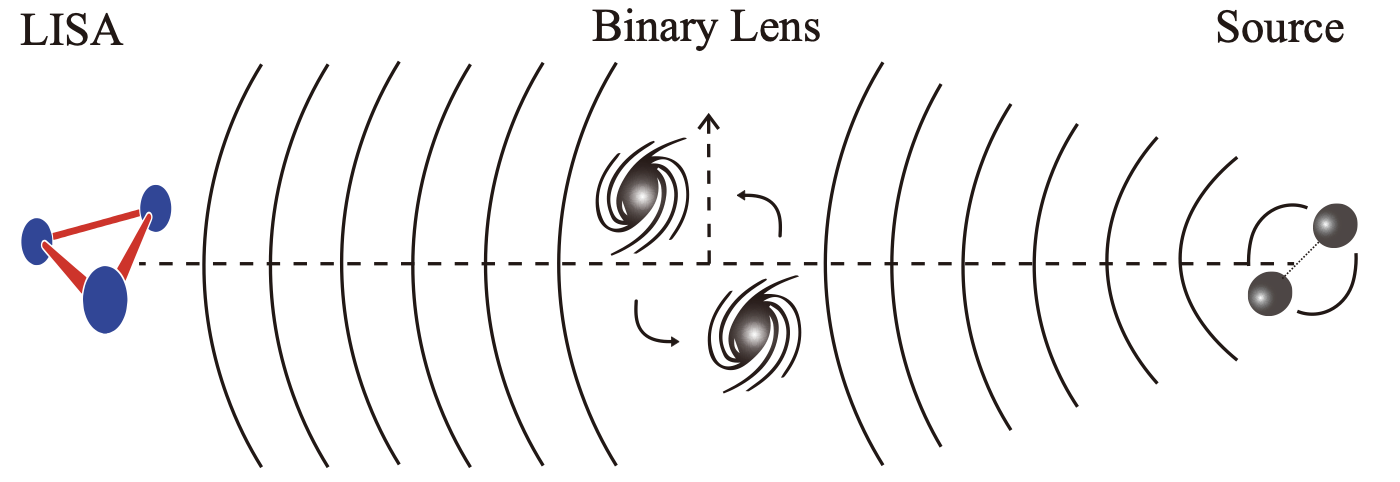
Gravitational lensing by supermassive black hole binaries. I simulated gravitational waves propagating past an inspiraling supermassive black hole binary acting as a lens, and found amplitude modulations with waveform mismatches up to 9.18%, comparable to levels shown to be detectable.
- Y. Qiu, K. Wang, J.-H. He, Amplitude modulation in binary gravitational lensing of gravitational waves, preprint (2022) [arXiv]
Current directions
- Long-duration mergers: 1–2 second binary neutron star merger simulations combining full M1 transport with GRMHD, following the co-evolution of the neutrino-driven wind and a possible jet, and turning the ejecta into r-process yields and kilonova light curves.
- Magnetic field amplification: high-resolution GRMHD + M1 runs (down to ~23 m) to see how magnetic fields are amplified after merger, whether they saturate, and whether a jet is launched.
- Beyond two-moment transport: 3D merger simulations with Boltzmann neutrino transport in AthenaK, to quantify the error budget of the M1 approximation and to evolve neutrino quantum kinetics (flavor coherence) directly.
- Faster microphysics: compact neural-network kernels (Kolmogorov–Arnold networks) that can be inlined into GPU code, so that the cost of exact neutrino transport is no longer dominated by microphysics.
See all publications.
Research before graduate school
- Solving Einstein's equations with the finite element method — research assistant, Nanjing University (2021–2022)
- Testing the uncertainty of ringdown overtone models — remote summer internship, AEI Hannover (2021)
- Gravitational waves in scalar-vector-tensor gravity — B.S. thesis, Dalian University of Technology (2021)
- Experimental nuclear astrophysics — summer internship, Institute of Modern Physics, Chinese Academy of Sciences (2020)
- China Undergraduate Physics Tournament (CUPT)
- Application of machine learning in quantum field theory — undergraduate innovation program