Notes by year: 2025 · 2024 · 2022 · 2021
This is a note page in which I have collected my interested arXiv preprints (gr-qc) and ranked in time. All the figures are credited to the corresponding paper linked above them.
Please click here to refresh the page if the formulas are not rendered.
Note: now it's the five year I do my readings. I am now a third-year PhD student!
Jan
1-4
The Kratos Framework for Hetrogeneous Astrophysical Simulations: Fundamental Infrastructures and Hydrodynamics
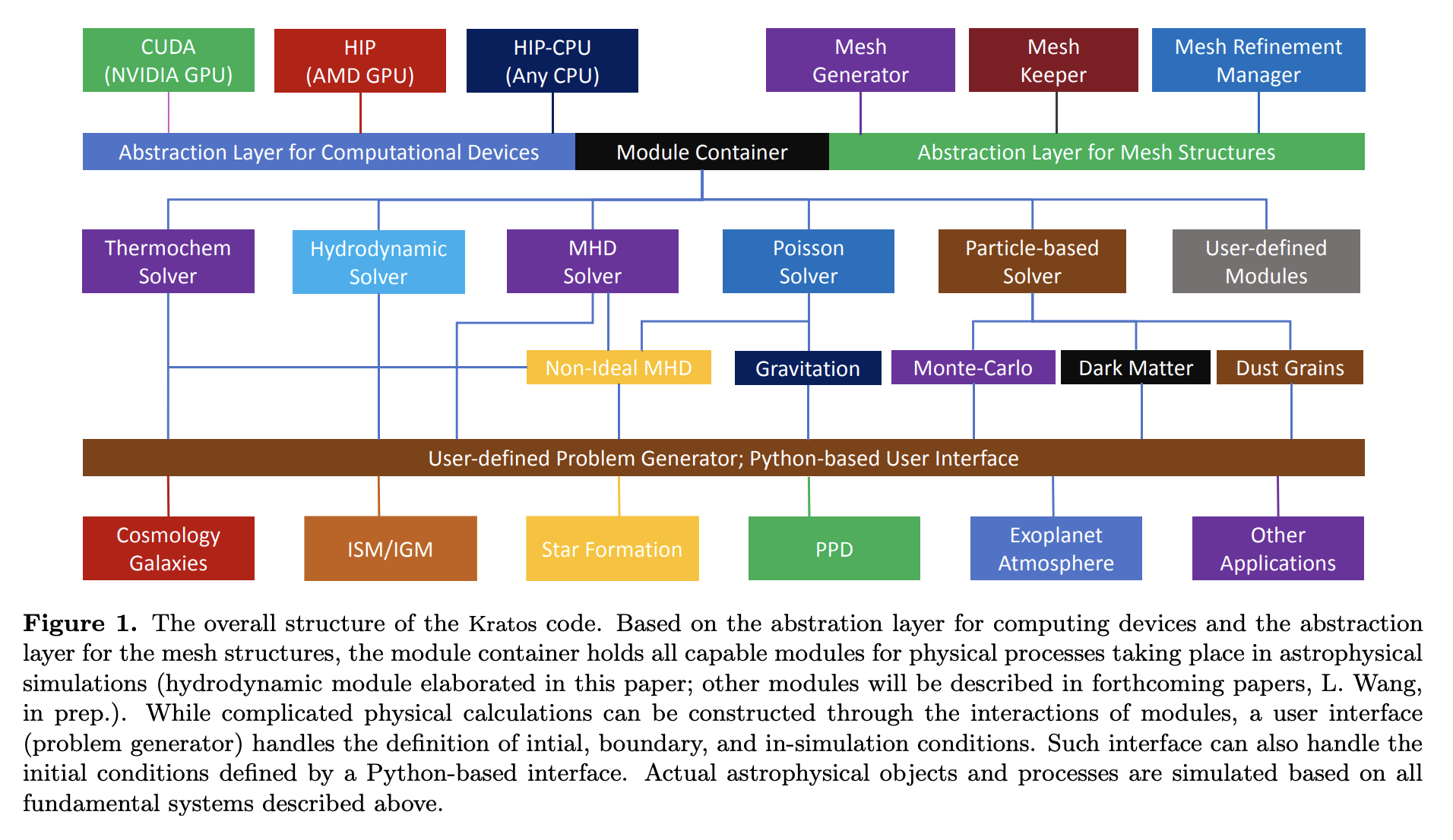
This paper describes the Kratos Framework, a novel GPU-based simulation system tailored for astrophysical simulations on heterogeneous devices. Kratos is designed to harness modern GPUs, providing a flexible and efficient platform for simulating a broad spectrum of astrophysical phenomena. It fundamental infrastructures relies on abstraction layers for devices, a multiprocessing communication model, and a mesh management system. These buildingblocks are designed for heterogeneous computing environments (especially GPUs) consistently, preparing for the supports for various physical modules, including hydrodynamics (which is elaborated in this paper), and thermochemistry, magnetohydrodynamics, self-gravity, and radiative processes in forthcoming papers.
Kratos is constructed for the CUDA, HIP and similar GPU programming models, employing abstraction layers to insulate algorithms from programming model disparities
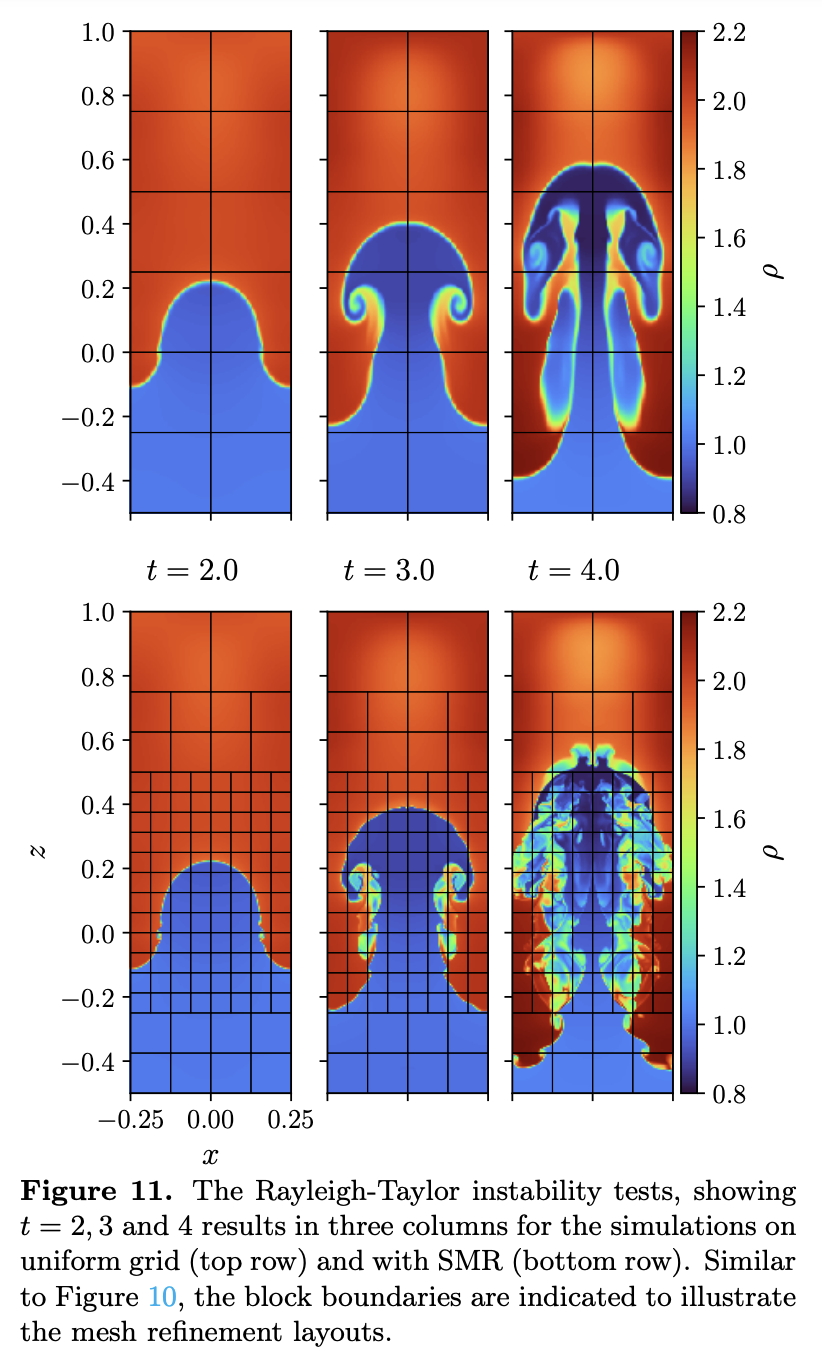
The hydrodynamics module of Kratos is constructed within the Godunov framework, and the default implementation of sub-modules are slope-limited Piecewise Linear Method (PLM) reconstruction, HLLC Riemann solver, and Heun time integrator. Optimizations for heterogeneous devices include variable conversion, boundary conditions, flux calculation, and time integration. Verification and performance tests include Sod shock tubes, double Mach reflection test, Liska-Wendroff implosion, Kelvin-Helmhotz instabilities, Rayleigh-Taylor instabilities, and colliding stellar outflows and ambients. These tests validate algorithms, robustness, and performance of Kratos with results aligning with analytic solutions and demonstrating the effectiveness of the hydrodynamics module under various conditions.
1-6
Stellar Tidal Disruptions by Newborn Neutron Stars or Black Holes: A Mechanism for Hydrogen-poor (Super)luminous Supernovae and Fast Blue Optical Transients
Core-collapse supernovae (SNe) have a large diversity in their photometric and spectroscopic appearances, which reflects the diversity in the progenitor's evolution and mass loss. The spectroscopic signature divides core-collapse SNe into two main types: Type II SNe from stars having hydrogen-rich envelopes, and Type Ibc SNe from stars that lost their hydrogen-rich envelope well before core-collapse. The leading channel for Type Ibc SNe is massive stars whose hydrogen-rich envelopes had been stripped off by binary interaction, typically with a main-sequence companion.
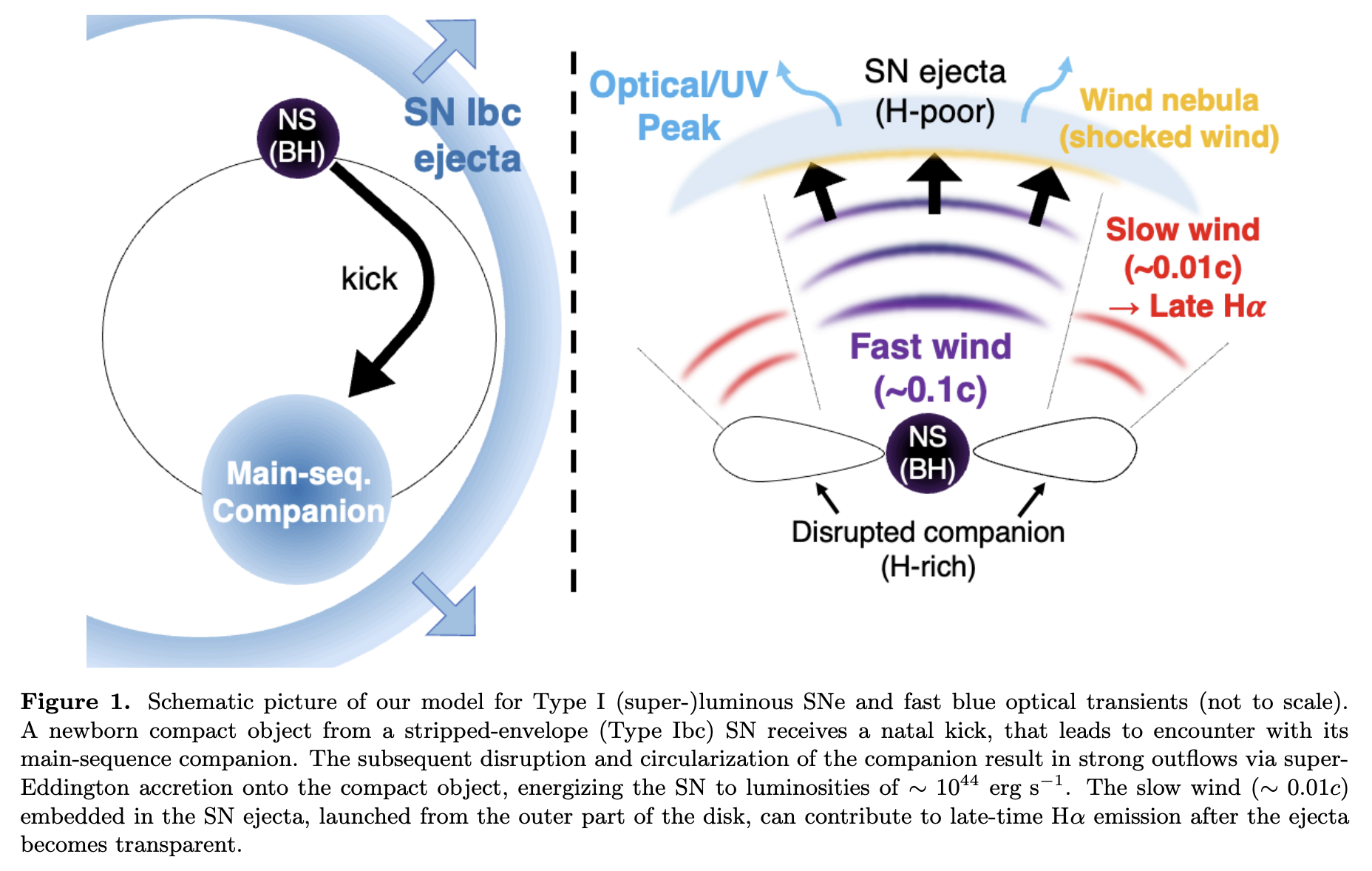
They further carried out a Monte-Carlo analysis to estimate the fraction of main-sequence disruptions following a SN event, finding that the fraction is sensitive to the orbital parameters like binary separation and companion mass.
1-10
Sapphire++: A particle transport code combining a spherical harmonic expansion and the discontinuous Galerkin method
Sapphire++ (“Simulating astrophysical plasmas and particles with highly relativistic energies in C++”), an open-source code designed to numerically solve the Vlasov–Fokker–Planck equation for astrophysical applications, which employs a numerical algorithm based on a spherical harmonic expansion of the distribution function. The code utilises the discontinuous Galerkin method in conjunction with implicit and explicit time stepping methods to compute these coefficients, providing significant flexibility in its choice of spatial and temporal accuracy.
The VFP equation in the system is, to first order in \(U / c\) (see for example)
\[ \left(1+\frac{\mathbf{U} \cdot \mathbf{V}^{\prime}}{c^2}\right) \frac{\partial f}{\partial t}+\left(\mathbf{U}+\mathbf{V}^{\prime}\right) \cdot \nabla_x f-\left(\gamma^{\prime} m \frac{\mathrm{~d} \mathbf{U}}{\mathrm{~d} t}+\left(\mathbf{p}^{\prime} \cdot \nabla_x\right) \mathbf{U}\right) \cdot \nabla_{p^{\prime}} f+q \mathbf{V}^{\prime} \cdot\left(\mathbf{B}^{\prime} \times \nabla_{p^{\prime}} f\right)=\frac{v^{\prime}}{2} \Delta_{\theta^{\prime}, \varphi^{\prime}} f \] where the primed quantities are given in the rest frame of the background (magnetized) fluid.
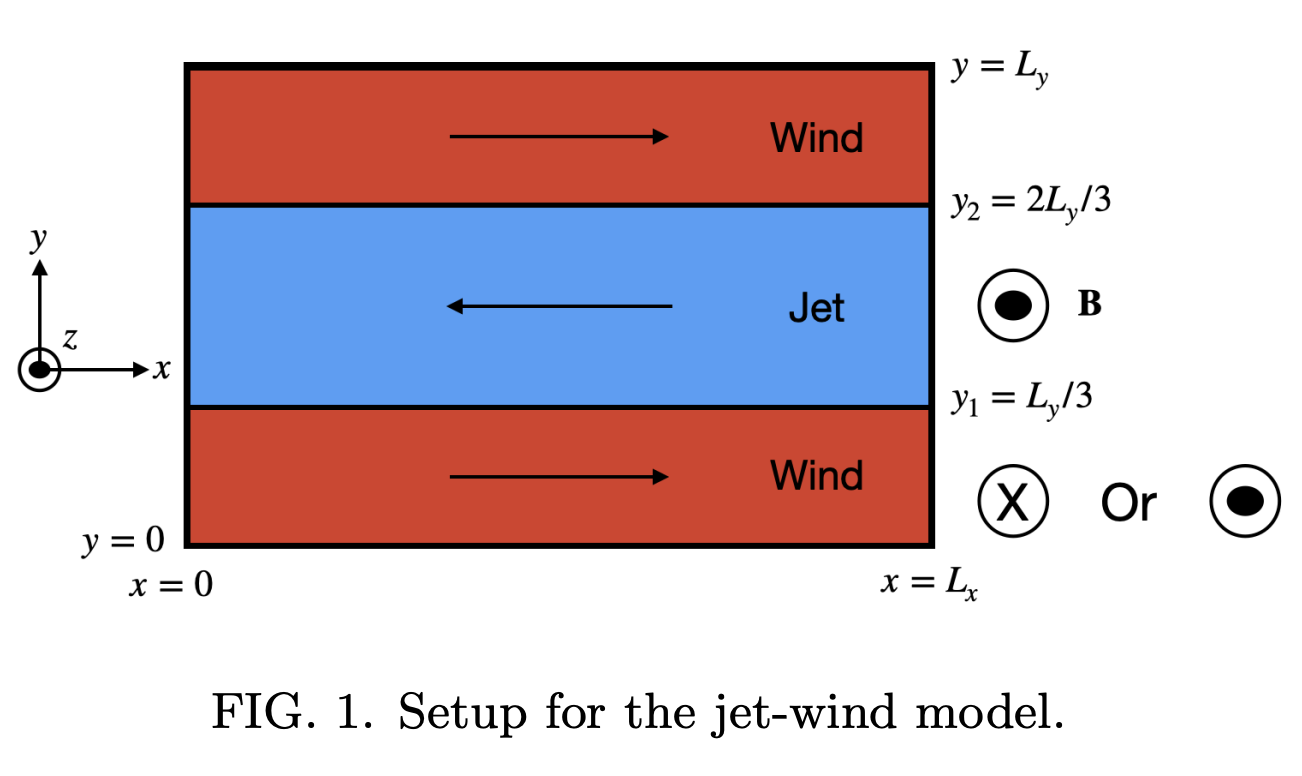
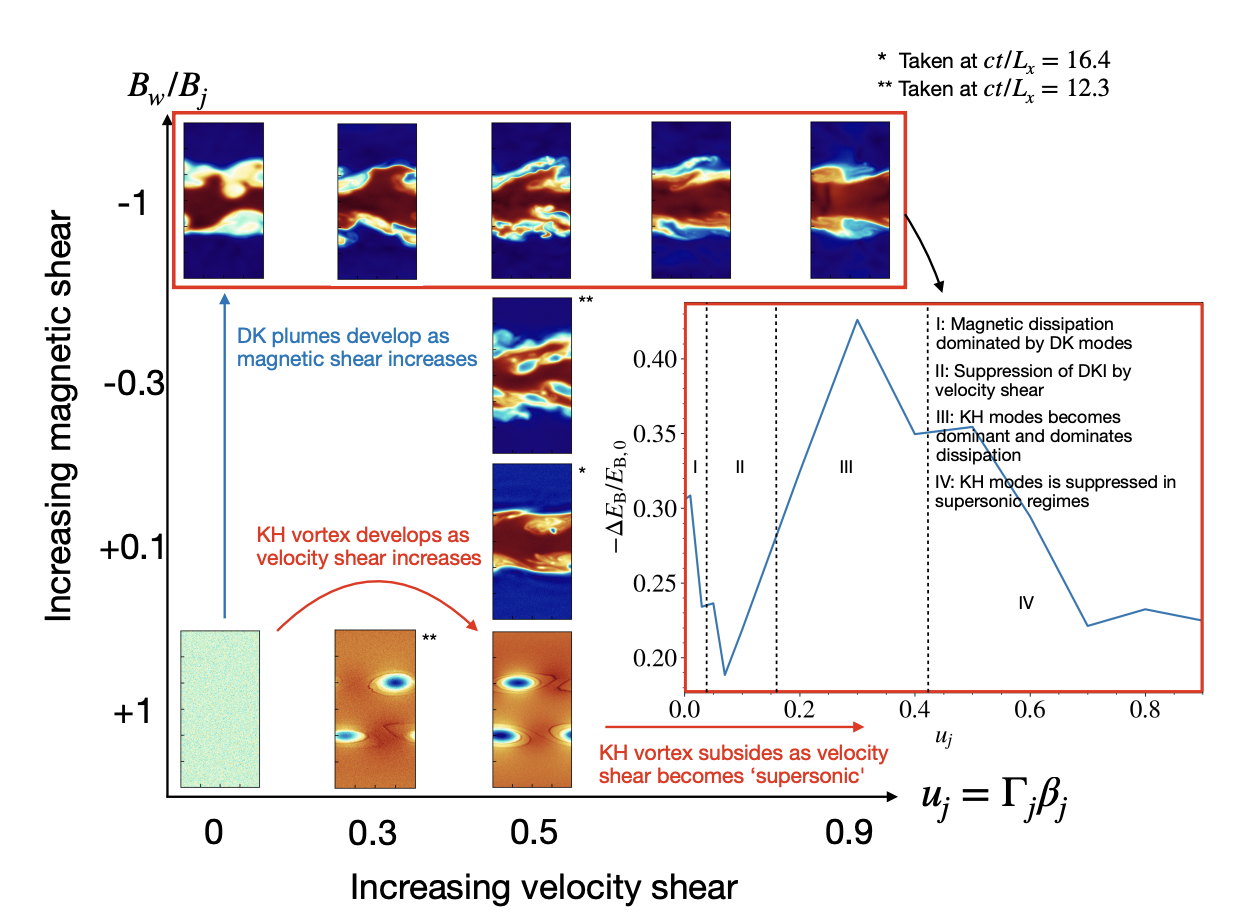
Dissipation and particle acceleration in astrophysical jets with velocity and magnetic shear: Interaction of Kelvin-Helmholtz and Drift-Kink Instabilities
This paper presents 2D particle-in-cell simulations of a magnetized, collisionless, relativistic pair plasma subjected to combined velocity and magnetic-field shear, a scenario typical for astrophysical blackhole jet-wind boundaries. The conditions only allow the Kelvin-Helmholtz (KH) and DriftKink (DK) instabilities to develop, while tearing modes are forbidden. They find that DKI can effectively disrupt the cat’s-eye vortices generated by KHI, creating a turbulent shear layer on the DK timescale. This interplay leads to a significant enhancement of dissipation over cases with only velocity shear or only magnetic shear. This study highlights the sensitivity of dissipation to multiple simultaneous instabilities, thus providing a strong motivation for further studies of their nonlinear interaction at the kinetic level.
1-12
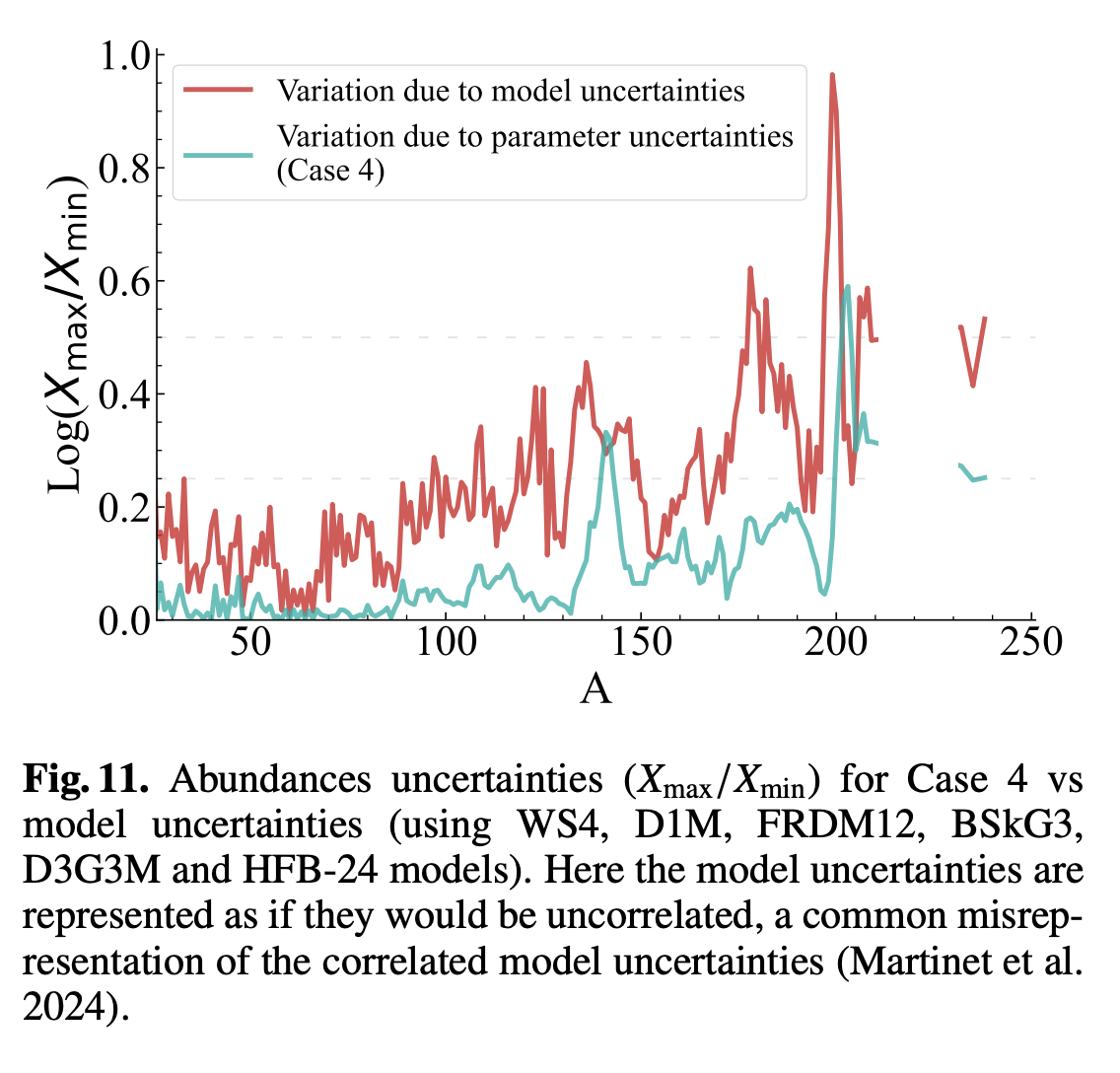
The impact of mass uncertainties on the r-process nucleosynthesis in neutron star mergers
- Theoretically predicted yields of elements created by the r-process carry potentially large uncertainties associated with incomplete knowledge of nuclear properties and approximative hydrodynamical modeling of the matter ejection processes.
- Aims. They investigate both the model (systematic) and parameter (statistical) uncertainties affecting nuclear mass predictions and explore their impact on the r-process production, and subsequently on the composition of neutron star merger ejecta. Methods. The impact of correlated model uncertainties on masses is estimated by considering five different nuclear mass models that are known to provide an accurate description of known masses. In addition, the uncorrelated uncertainties associated with local variation of model parameters are estimated using a variant of the backward-forward Monte Carlo method to constrain the parameter changes to experimentally known masses before propagating them consistently to the unknown masses of neutron-rich nuclei. The impact of nuclear mass uncertainties is propagated to the r-process nucleosynthesis in a 1.38-1.38 \(\mathbf{M}_{\odot}\) neutron star merger model considering a large and representative number of trajectories. Results. The uncorrelated parameter uncertainties lead to the ejected abundances uncertainties of \(20 \%\) up to \(A \simeq 130\), \(40 \%\) between \(A=150\) and 200, and peaks around \(A \simeq 140\) and \(A \simeq 203\) giving rise to deviations around 100 to \(300 \%\). The correlated model uncertainties remain larger than the parameter ones for most nuclei. However, both model and parameter uncertainties have an important impact on the heavy nuclei production. Conclusions. Improvements to nuclear models are still crucial in reducing uncertainties in predictions related to the r-process nucleosynthesis. Both correlated model uncertainties and determining coherently parameter uncertainties are key in the sensitivity analysis.
Jan 13
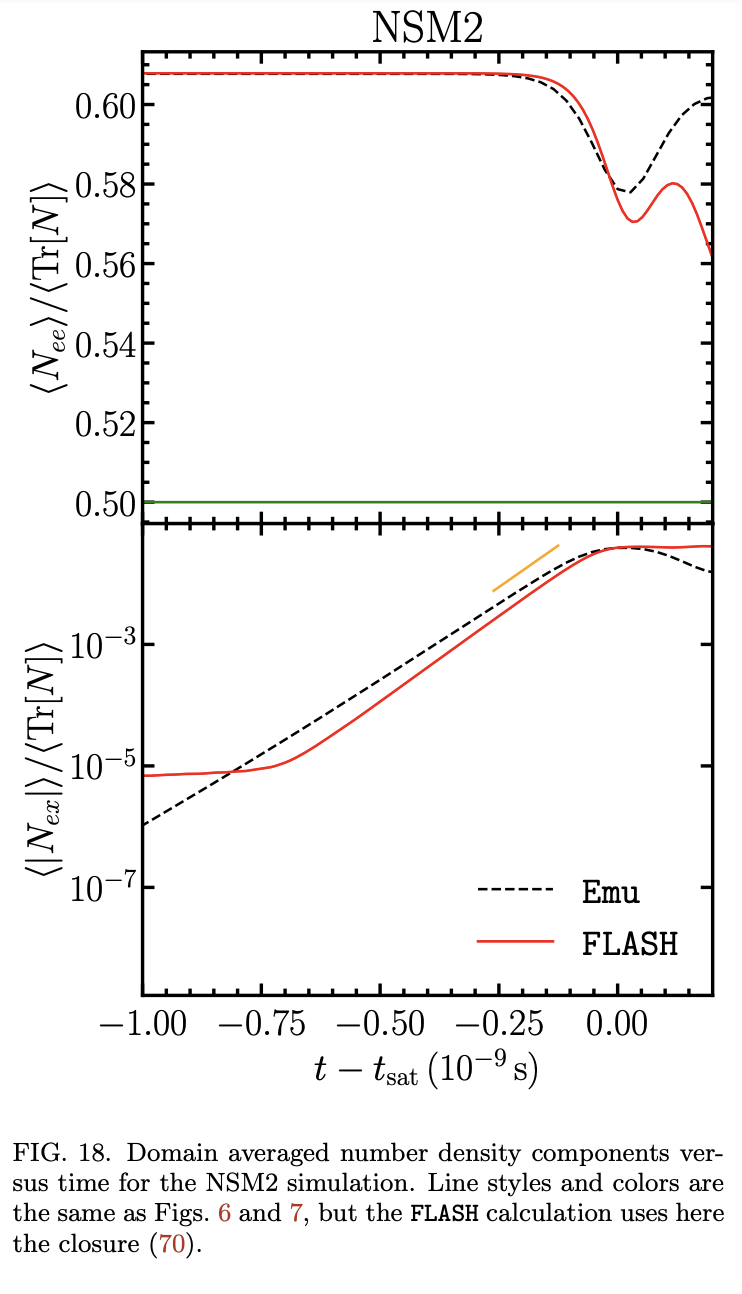
Advection Algorithms for Quantum Neutrino Moment Transport
- Evolving the angular moments of particle distributions is a time-tested approach for solving the equations of radiation hydrodynamics. A common method for solving the moment evolution equations is to discretize the moments in space/time/momentum and use a Riemann solver for the Riemann problem across the cell boundaries. Generalizing a Riemann solver for the transport of quantum moments - a necessity to deal with flavor transformation phenomena - is not a straightforward endeavor. They have identified two crucial issues that a Riemann solver needs to address: how to indicate the direction of flow of the flavor space coherence of the flux, and how to reconstruct the off-diagonal elements of the moments at the cell interfaces. Their solution for the first issue is to use a signed modulus to describe the flux moment, and to address the second issue, we designed a new reconstruction algorithm in the spirit of the well-known "minmod" limiter generalized to the complex plane.
- In all cases, the modulus phase implementation produces results that are closer to those of the particle-in-cell method.
Jan 14
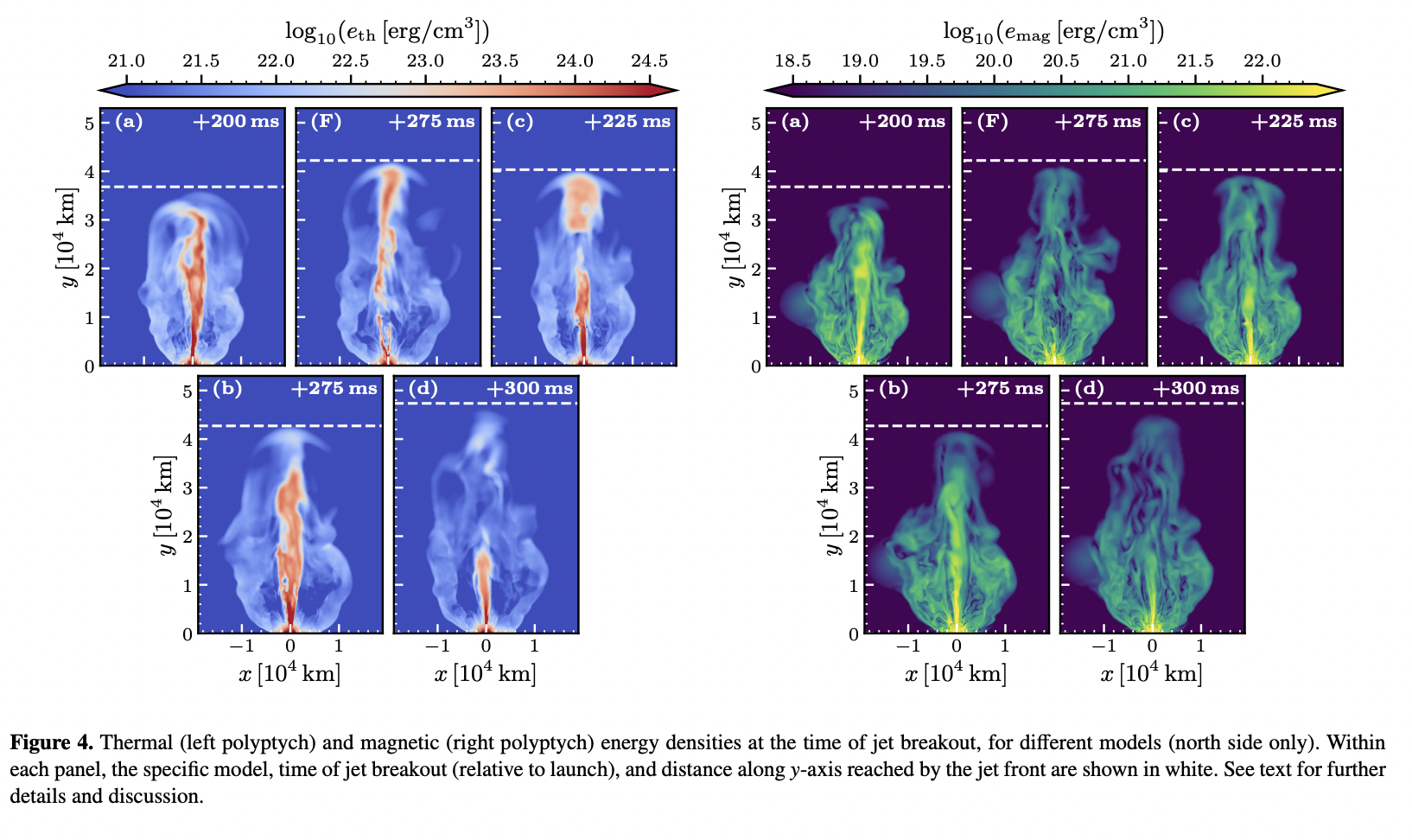
Role of injection parameters in jet propagation through realistic binary neutron star merger environments
- In this paper, they employ the numerical methods to conduct the first parameter study of GRB jets propagating through realistic BNS merger environments. Specifically, the first suite of 3D RMHD simulations of magnetized incipient GRB jets, manually injected with different luminosity, magnetization, power decay time scale, and launch time relative to merger, into a realistic magnetized environment resulting from a 3D GRMHD BNS merger simulation. They particularly focus on the impact of such parameters on the jet's dynamics, energetics, and final angular structure, providing quantitative details and comparison with state-of-the-art models in which instead simplified environments are adopted. In addition, the simulations extend up to 3 s after launch, significantly longer than the previous 3D RMHD simulations of GRB jets in BNS merger environments.
Jan 15
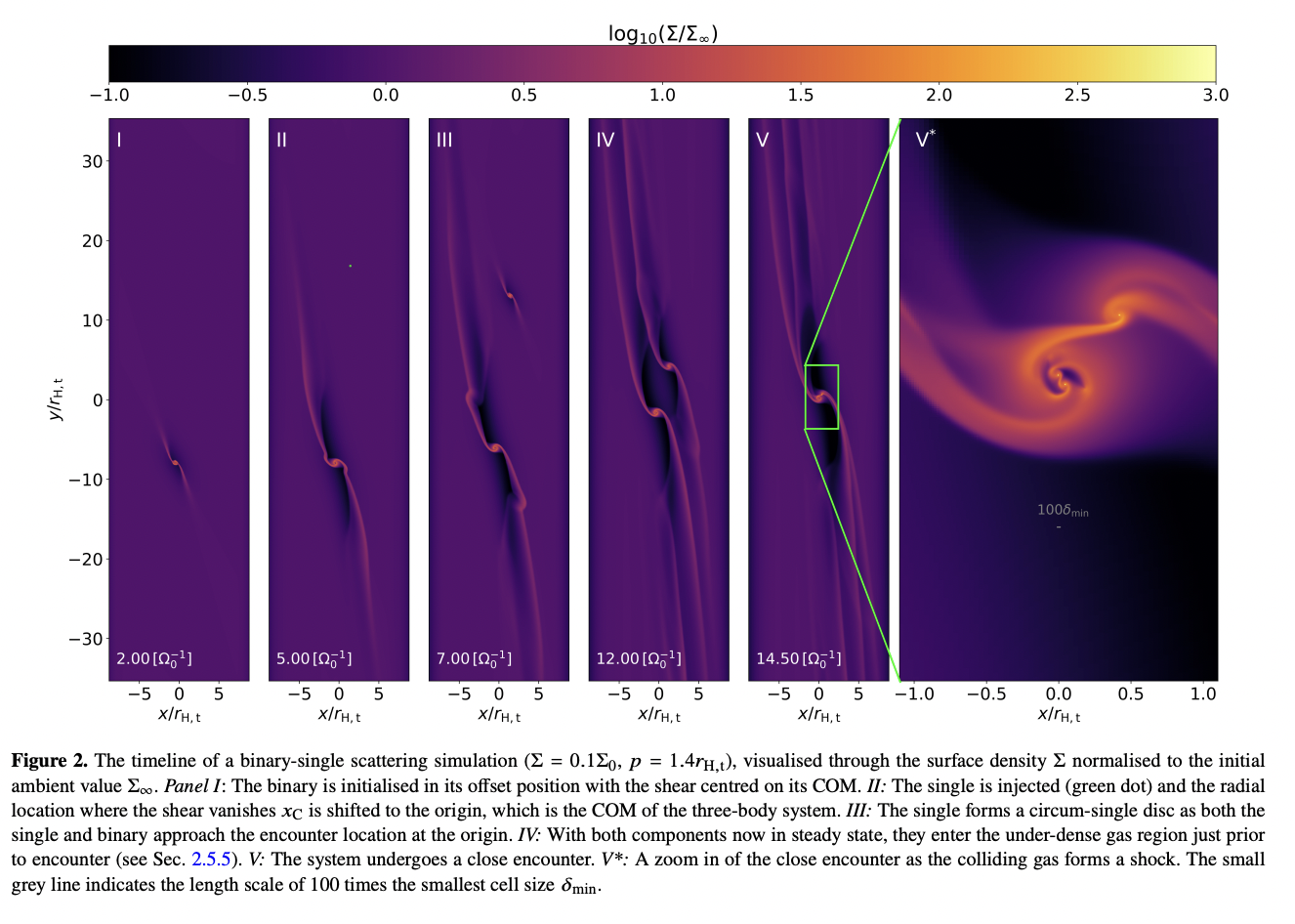
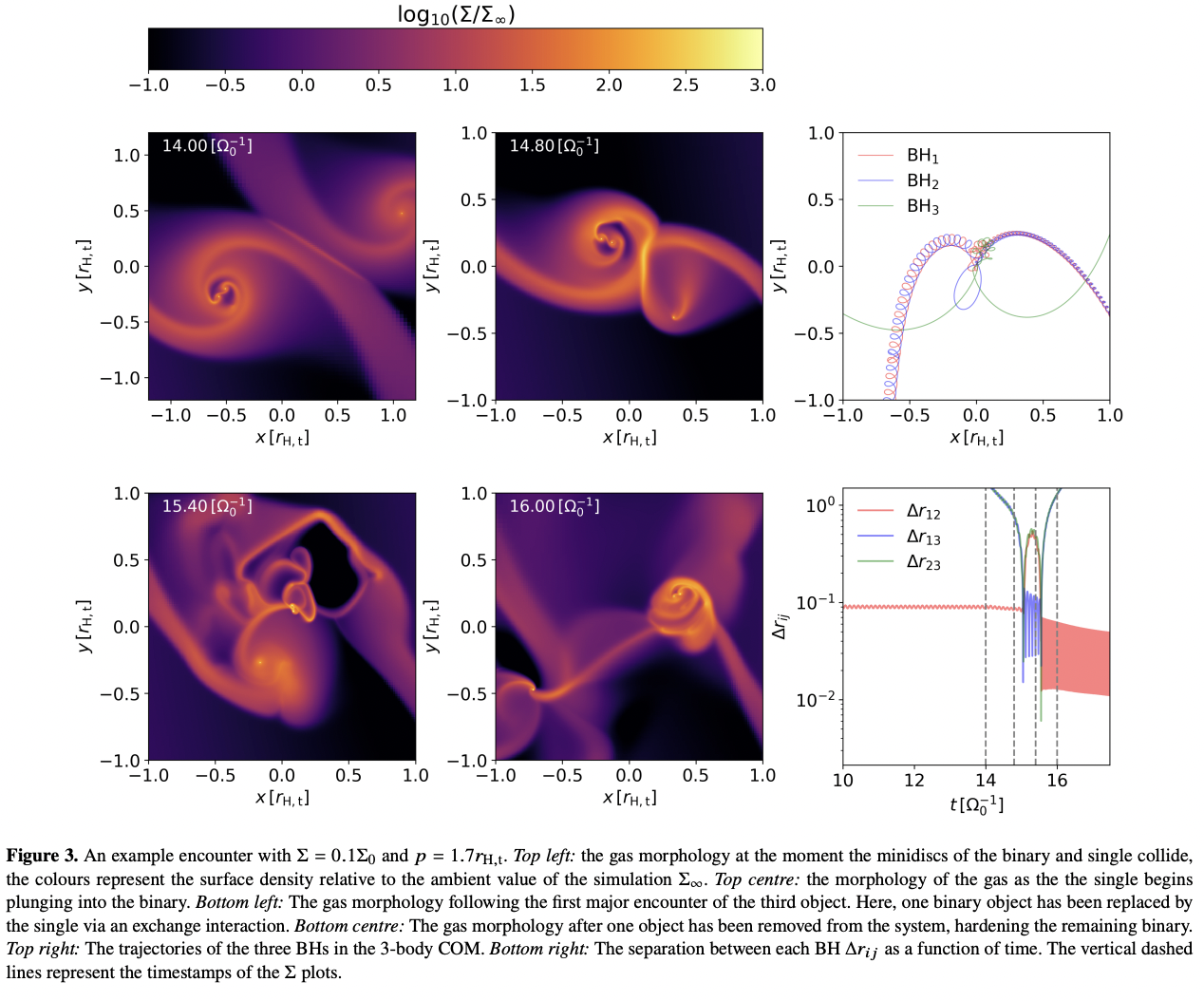
Prompt gravitational-wave mergers aided by gas in Active Galactic Nuclei: The hydrodynamics of binary-single black hole scatterings
Black hole binary systems embedded in AGN discs have been proposed as a source of the observed gravitational waves (GWs) from LIGO-Virgo-KAGRA. Studies have indicated binary-single encounters could be common place within this population, yet we lack a comprehensive understanding of how the ambient gas affects the dynamics of these three-body encounters. Using Athena++, they present the first hydrodynamical simulations of black hole binary-single encounters in an AGN disc. They find the gas is a non-negligible component of binary-single interactions, leading to unique dynamics, including the formation of quasi-stable hierarchical triples. The gas efficiently and reliably dissipates the energy of the three-body system, hardening the triple provided it remains bound after the initial encounter. The hardening timescale is shorter for higher ambient gas densities. Formed triple systems can be hardened reliably by \(2-3\) orders of magnitude relative to the initial binary semi-major axis within less than a few AGN orbits, limited only by resolution. Their results suggest that current timescale estimates (without gas drag) for binary-single induced mergers are an upper bound. The shrinkage of the triple by gas has the prospect of increasing the chance for unique GW phenomena such as residual eccentricity, dephasing from a third object and double GW mergers.
Jan 16
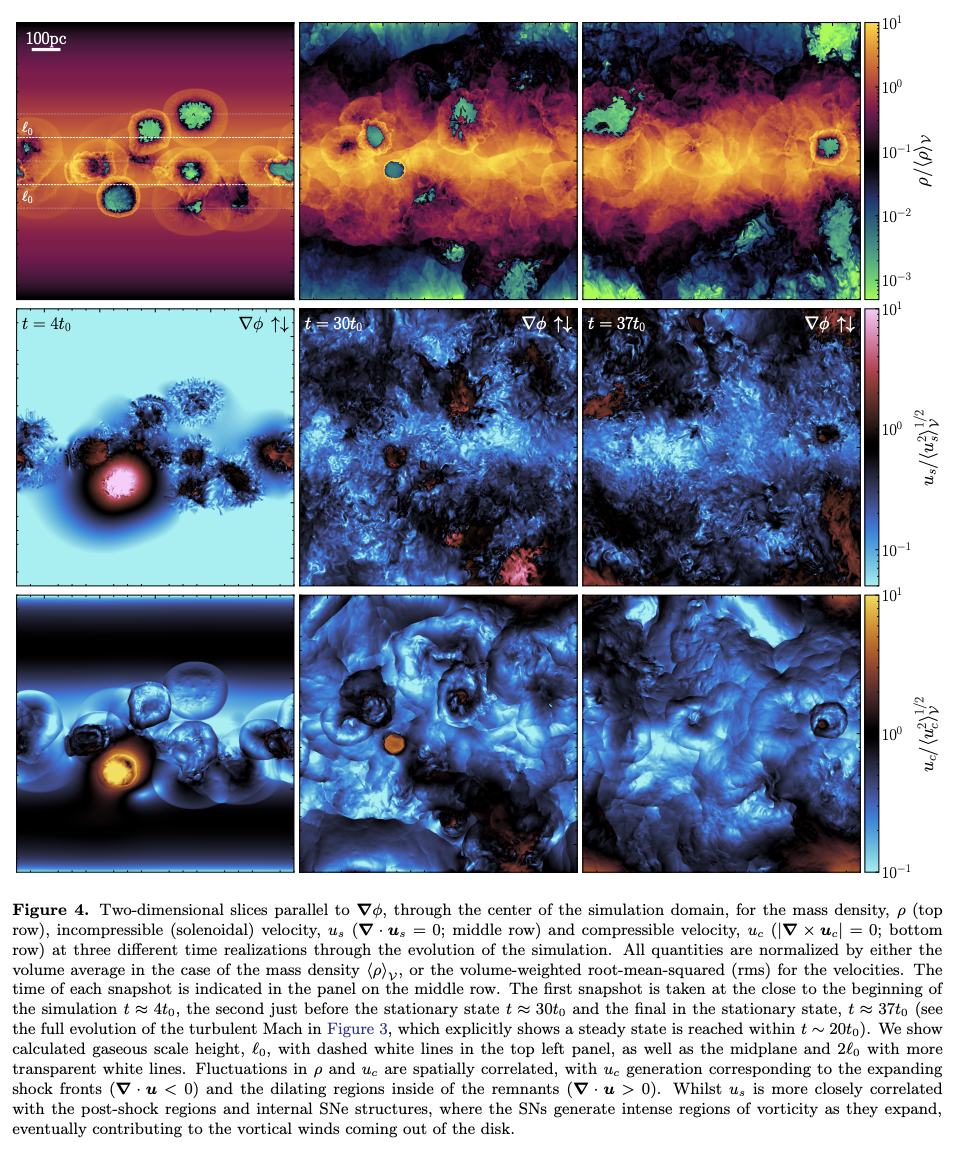
So long Kolmogorov: the forward and backward turbulence cascades in a supernovae-driven, multiphase interstellar medium
- The interstellar medium (ISM) of disk galaxies is turbulent, and yet the fundamental nature of ISM turbulence, the energy cascade, is not understood in detail. In this study, they use high-resolution simulations of a hydrodynamical, gravitationally stratified, supernova ( SNe )-driven, multiphase ISM to probe the nature of a galactic turbulence cascade. Through the use of kinetic energy flux transfer functions split into interactions between compressible \(\boldsymbol{u}_c\) and incompressible \(\boldsymbol{u}_s\) modes, they show that there exists a large-to-small-scale cascade in both \(\boldsymbol{u}_c\) and \(\boldsymbol{u}_s\) when mediated by an additional \(\boldsymbol{u}_s\) mode. But the \(\boldsymbol{u}_s\) cascade is highly non-local. Moreover, there is a \(\boldsymbol{u}_c\) mediated component of the \(\boldsymbol{u}_s\) cascade that proceeds in the opposite direction - an inverse cascade from small-to-large scales. The cascade feeds flux into scales well beyond the gaseous scale height, energizing the winds and fueling the direct cascades.
Jan 20
Robust and fast parameter estimation for gravitational waves from binary neutron star merger remnants
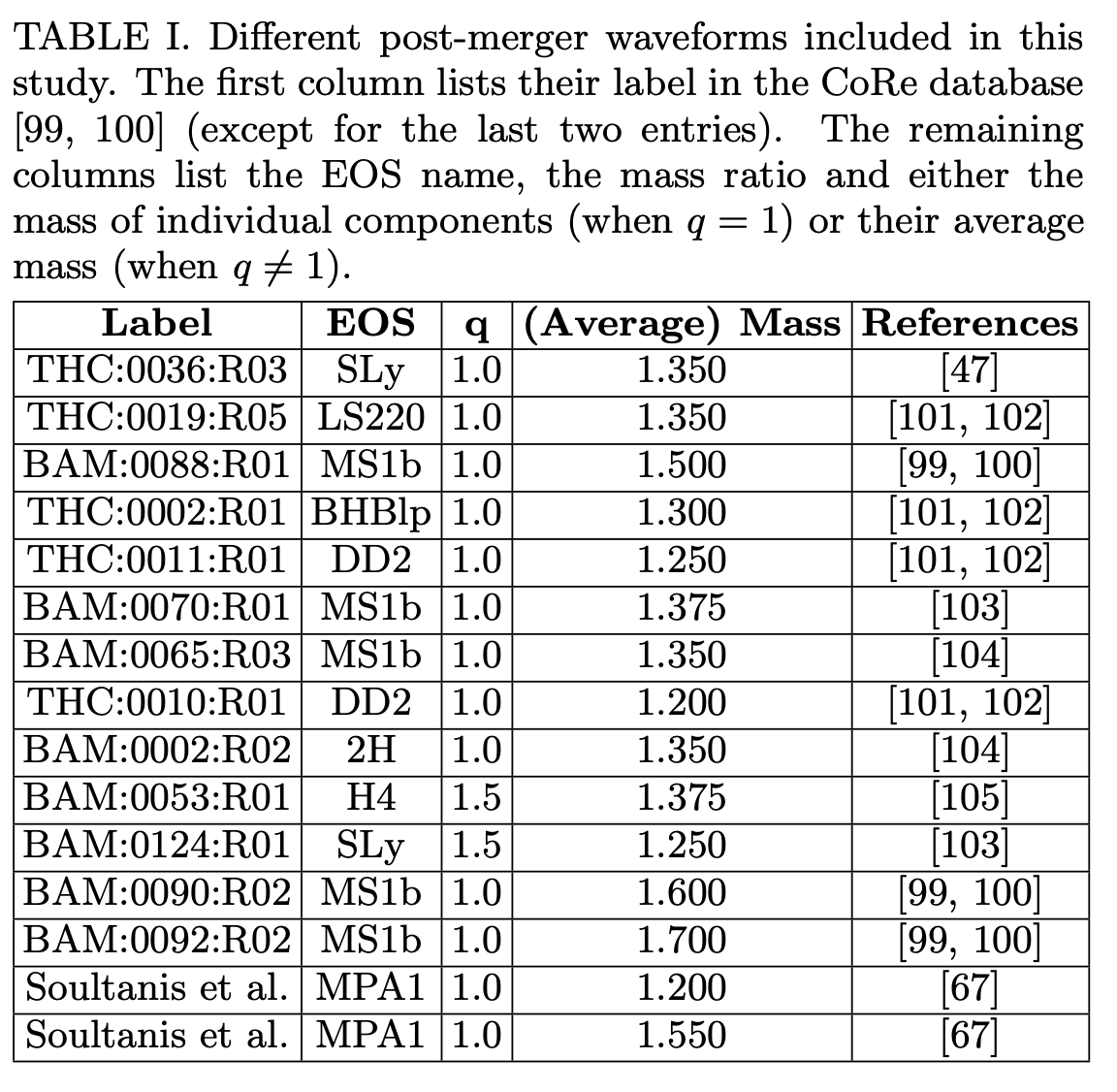
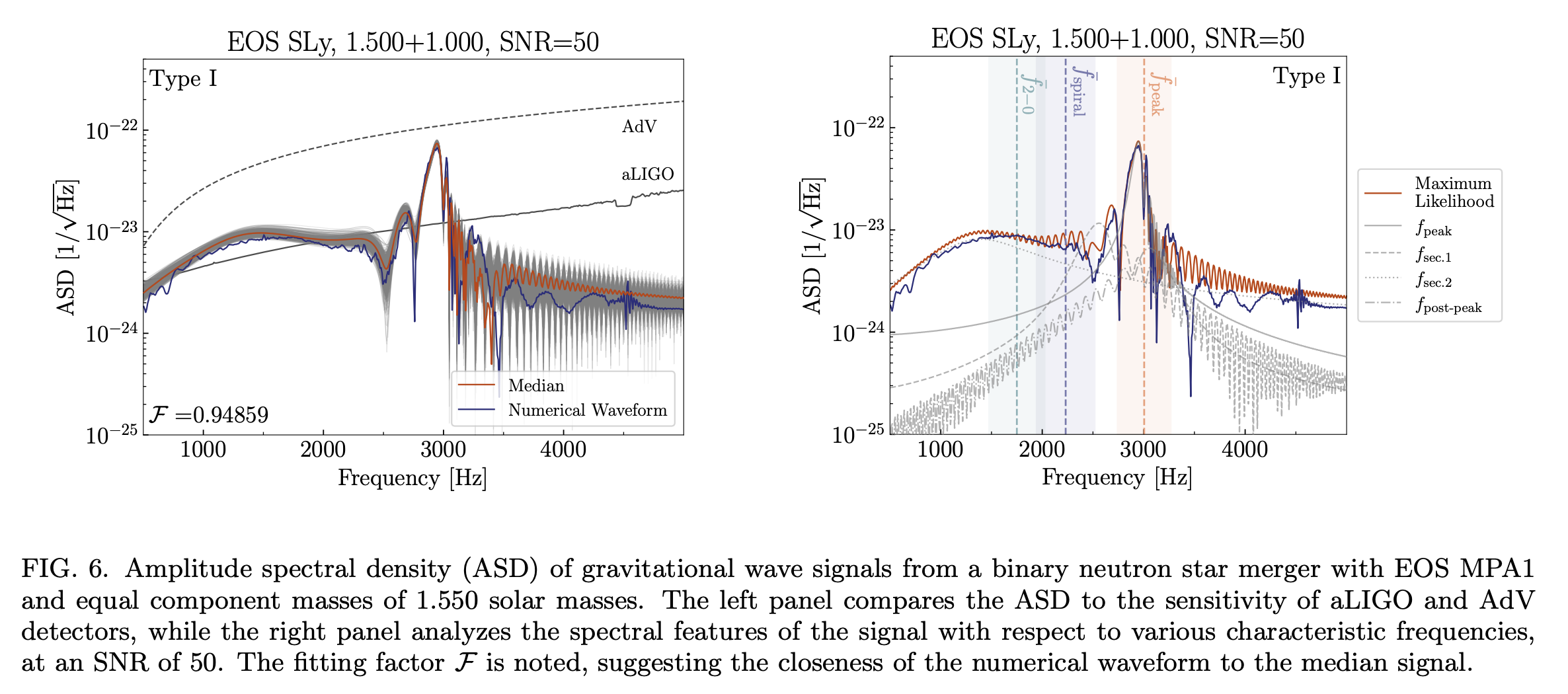
They present a robust and efficient methodology for parameter estimation of gravitational waves generated during the post-merger phase of binary neutron star mergers. Their approach leverages an analytic waveform model combined with empirical relations to predict prior ranges for the postmerger frequencies based on measurements of the chirp mass and effective tidal deformability in the inspiral phase. This enables robust inference of the main features of the post-merger spectrum, avoiding possible multi-modality induced by wide priors. Using waveforms derived from numerical relativity, they systematically validate our model across a broad spectrum of neutron star equations of state and mass configurations, demonstrating high fitting factors. This method can be applied in future detections of gravitational waves from the post-merger phase with third-generation gravitational wave observatories. Furthermore, by integrating the Preconditioned Monte Carlo sampling method within the pocoMC framework, they achieve substantial computational acceleration compared to conventional Bayesian techniques.
Jan 21
A Realistic Projection for Constraining Neutron Star Equation of State with the LIGO-Virgo-KAGRA Detector Network in the A+ Era
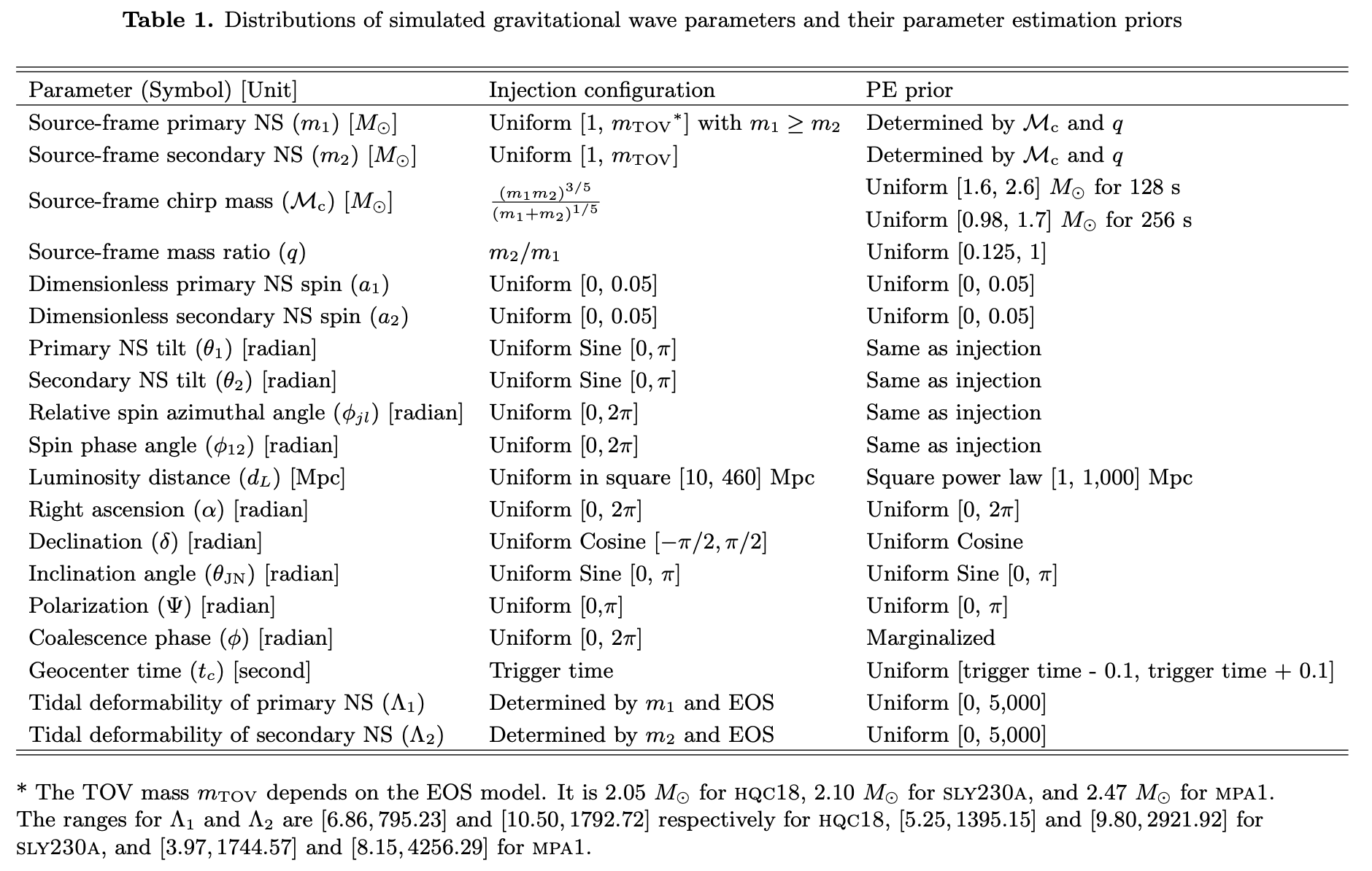
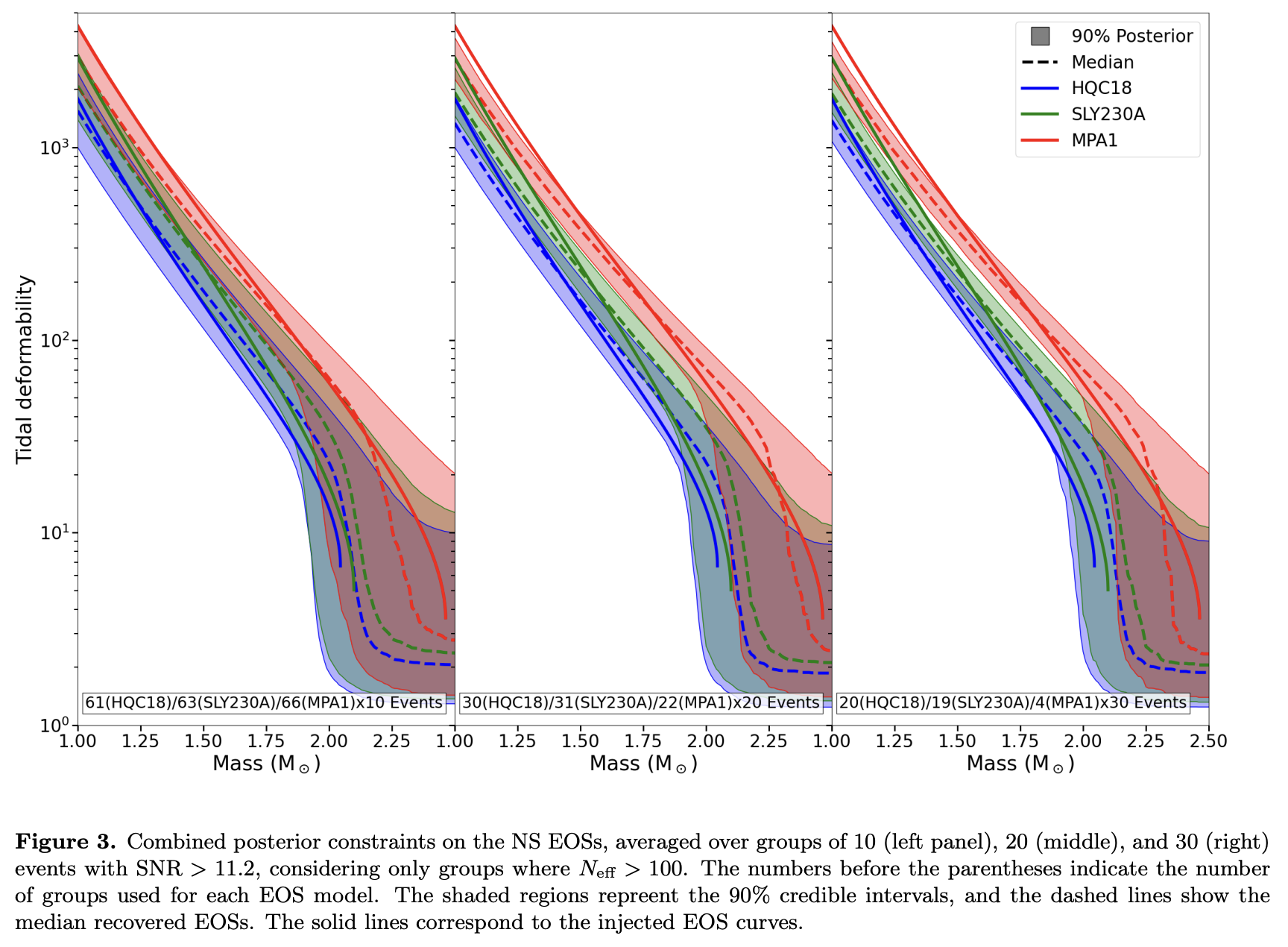
The LIGO-Virgo-KAGRA network in the upcoming A+ era with upgrades of both Advanced LIGO (aLIGO+) and Advanced Virgo (AdV+) will enable more frequent and precise observations of binary neutron star (BNS) mergers, improving the constraints on neutron star equation of state (EOS). In this study, they applied reduced order quadrature (ROQ) techniques for full parameter estimation of 3,000 simulated gravitational wave signals from BNS mergers at A+ sensitivity following three EOS models-HQC18, SLY230A, and MPA1. They found that tidal deformability tend to be overestimated at higher mass and underestimated at lower mass.
Jan 22
The neutrino luminosity and energy spectrum of nova outburst
The generation of neutrinos inside stars can be broadly categorized into two distinct processes. One is weak nuclear processes, including \(\beta^{ \pm}\)decay and \(e^{ \pm}\) capture (Kato et al. 2020):
\[ \begin{aligned} & \text {nuclei } \mathrm{EC}:(\mathrm{Z}, \mathrm{~A})+\mathrm{e}^{-} \longrightarrow(\mathrm{Z}-1, \mathrm{~A})+\nu_{\mathrm{e}} \\ & \text {freep } \mathrm{EC}: \mathrm{p}+\mathrm{e}^{-} \longrightarrow \mathrm{n}+\nu_{\mathrm{e}} \\ & \mathrm{PC}:(\mathrm{Z}, \mathrm{~A})+\mathrm{e}^{+} \longrightarrow(\mathrm{Z}+1, \mathrm{~A})+\bar{\nu}_{\mathrm{e}} \\ & \beta^{+}:(\mathrm{Z}, \mathrm{~A}) \longrightarrow(\mathrm{Z}-1, \mathrm{~A})+\mathrm{e}^{+}+\nu_{\mathrm{e}} \\ & \beta^{-}:(\mathrm{Z}, \mathrm{~A}) \longrightarrow(\mathrm{Z}+1, \mathrm{~A})+\mathrm{e}^{-}+\bar{\nu}_{\mathrm{e}} \end{aligned} \] Such as \(\mathrm{p}\left(\mathrm{p}, \mathrm{e}^{+} \nu\right) \mathrm{d}, \mathrm{p}\left(\mathrm{e}^{-} \mathrm{p}, \nu_{\mathrm{e}}\right) \mathrm{d},{ }^3 \mathrm{He}\left(\mathrm{p}, \mathrm{e}^{+} \nu_{\mathrm{e}}\right) \alpha\) in pp chains, \({ }^{13} \mathrm{~N}\left(, \mathrm{e}^{+} \nu_{\mathrm{e}}\right){ }^{13} \mathrm{C},{ }^{15} \mathrm{O}\left(, \mathrm{e}^{+} \nu_{\mathrm{e}}\right){ }^{15} \mathrm{~N},{ }^{17} \mathrm{~F}\left(, \mathrm{e}^{+} \nu_{\mathrm{e}}\right){ }^{17} \mathrm{O}\) in CNO cycle.
The other is thermal processes, which are sensitive to temperature and density. Thermal neutrino energy losses are from Itoh et al. (1996), including: pair annihilation \(\left(\mathrm{T}>10^9 \mathrm{~K}\right)\) \[ \begin{gathered} e^{+}+e^{-} \longrightarrow \nu+\bar{\nu} \\ \text { photon-neutrino }\left(\mathrm{T}<4 \times 10^8 \mathrm{~K}, \rho<10^5 \mathrm{~g} \mathrm{~cm}^{-3}\right) \\ e^{-}+\gamma \longrightarrow e^{-}+\nu+\bar{\nu} \\ \text { plasma decay }\left(10^7<\mathrm{T}<10^8 \mathrm{~K}, 10^4<\rho<10^7 \mathrm{~g} \mathrm{~cm}^{-3}\right) \\ \gamma^* \longrightarrow \nu+\bar{\nu} \\ \text { bremsstrahlung }\left(10^8<\rho<10^{10} \mathrm{~g} \mathrm{~cm}^{-3}\right) \\ e^{-}+(Z, A) \longrightarrow e^{-}+(Z, A)+\nu+\bar{\nu} \end{gathered} \]
Gravitational Wave Decoupling in Retrograde Circumbinary Disks
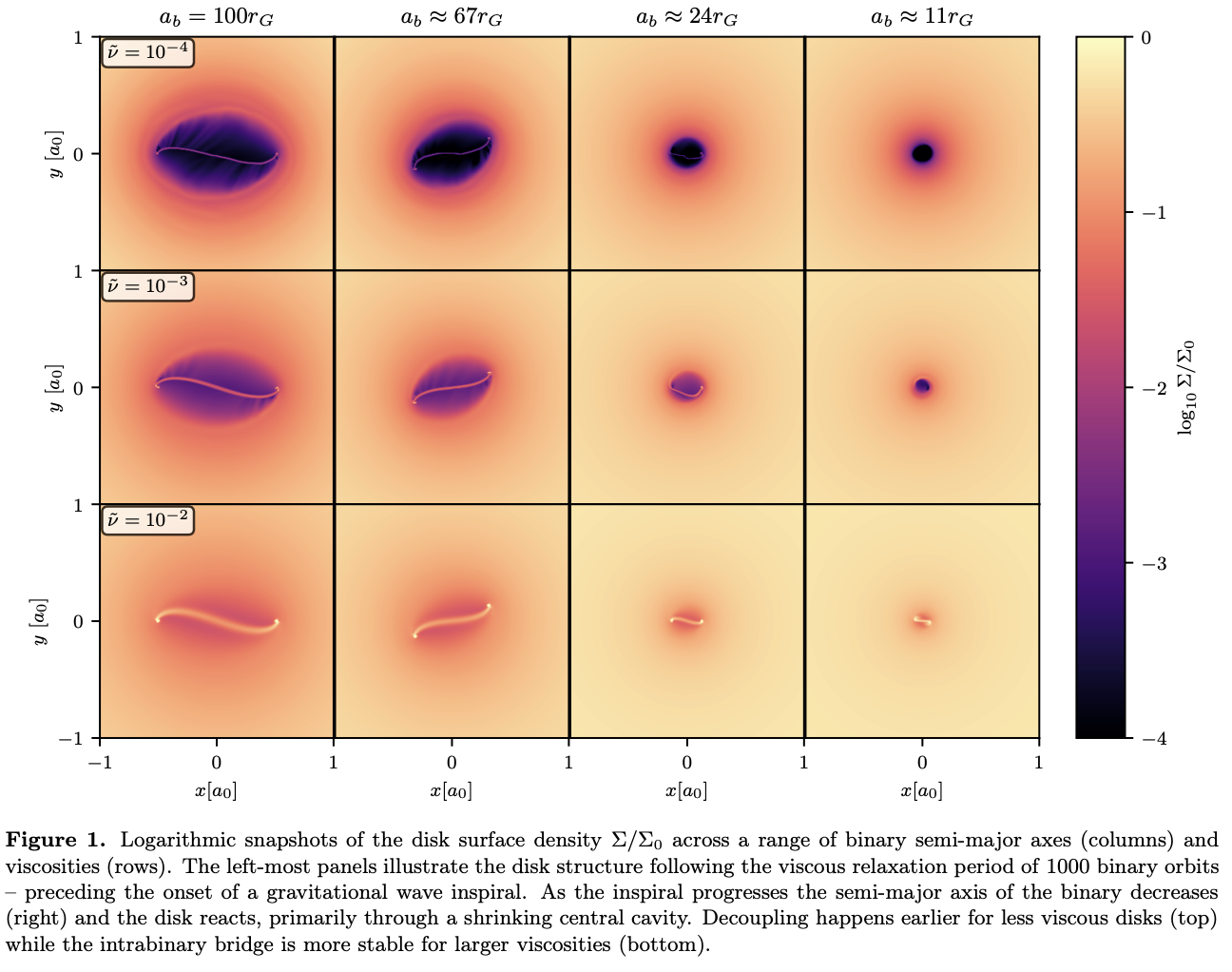
- This work presents a study of the late-time interaction between supermassive black hole binaries and retrograde circumbinary disks during the period of gravitational wave-driven inspiral. While mergers in prograde disks have received extensive study, retrograde disks offer distinct dynamics that could promote mergers and produce unique observational signatures.
- They have performed numerical hydrodynamic simulations of retrograde circumbinary disks, hosting an equalmass binary undergoing gravitational wave inspiral. They have compared our results directly with prograde counterparts, to better understand the differences between prograde and retrograde disk configurations.
Jan 23
Accelerating Numerical Relativity with Code Generation: CUDA-enabled Hyperbolic Relaxation
- Numerical relativity (NR) faces significant challenges in generating GW catalogs at the required scale and accuracy on modern computers, as NR codes do not fully exploit modern GPU capabilities. In response, they extend NRPy, a Python-based NR code-generation framework, to develop NRPyEllipticGPU-a CUDA-optimized elliptic solver tailored for the binary black hole (BBH) initial data problem. NRPyEllipticGPU is the first GPU-enabled elliptic solver in the NR community, supporting a variety of coordinate systems and demonstrating substantial performance improvements on both consumer-grade and HPC-grade GPUs. They show that, when compared to a high-end CPU, NRPyEllipticGPU achieves on a highend GPU up to a sixteenfold speedup in single precision while increasing doubleprecision performance by a factor of \(2-4\). This performance boost leverages the GPU's superior parallelism and memory bandwidth to achieve a compute-bound application and enhancing the overall simulation efficiency. As NRPyEllipticGPU shares the core infrastructure common to NR codes, this work serves as a practical guide for developing full, CUDA-optimized NR codes.
- BBH systems form the foundation of compact binary GW data analysis. Simulating such a system involves two basic steps: first, solving a set of elliptic partial differential equations (PDEs) to compute the initial data solution; and second, evolving this data forward in time by solving a system of hyperbolic PDEs (see e.g., [11, 12] for comprehensive reviews). Both calculations are computationally intensive, with the computational cost increasing for higher binary mass ratio and the component spins of the BHs.
- In an effort to effectively leverage the latest HPC resources, the NR community continues to develop GPU-accelerated applications, with a primary focus on the time evolution of dynamical spacetimes. For general relativistic magnetohydrodynamic (GRMHD) simulations of isolated objects, known frameworks include AsterX [19] and GRaM-X [20], both of which use the new Einstein Toolkit [21] driver CarpetX, built on the AMReX [22] programming framework. In contrast, Kokkos has been employed to rewrite Athena++ into more portable implementations, including the multi-physics framework Parthenon [23, 24], as well as AthenaK, which supports simulations of BBHs [25] and GRMHD studies of binary and isolated neutron stars [26]. In addition, NR frameworks natively ported using CUDA include SpEC [27], optimized for simulating isolated BHs, and Dendro-GR [28], designed for BBH simulations.
Jan 24
Resolution requirements for numerical modeling of neutrino quantum kinetics
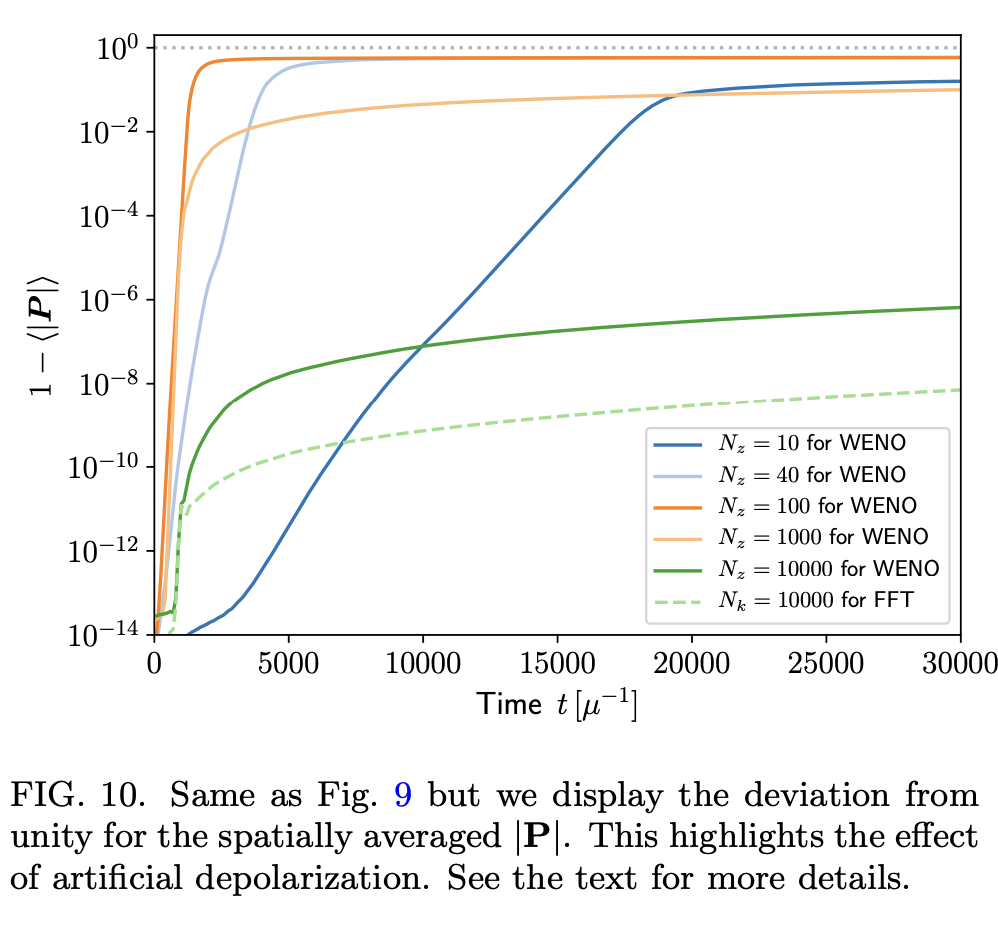
- In this paper, they conduct a comprehensive resolution study in both angular- and spatial directions by using two independent schemes of quantum kinetic neutrino transport: finite volume and pseudospectral methods. They complement our discussion by linear stability analysis including inhomogeneous modes. Their result suggests that decreasing spatial resolutions underestimates the growth of flavor instability, and then leads to wrong asymptotic states of flavor conversions, which potentially has a critical impact on astrophysical consequences.
- They employ a neutrino transport code by a finite volume approach with seventh-ordered weighted essentially non-oscillatory (WENO) scheme, while the fourth-order Runge-Kutta method is used for time integration. Such high-order numerical schemes are necessary to accurately capture the interplay between collective neutrino oscillations with neutrino advection.
- They find that the growth rate of flavor conversion is underestimated, if the maximum growth mode is not properly captured. In these low resolution simulations, the asymptotic state of flavor conversions is qualitatively different from that in higher resolution models resolving all unstable modes of flavor instabilities. This is attributed to the fact that low spatial resolution models do not have abilities to erase ELN-XLN angular crossings which corresponds to a driving force of FFC. As a result, the angular resolution of neutrinos in low spatial resolutions becomes different from the highest resolution model.
Jan 25
Three-dimensional core-collapse supernova models with phenomenological treatment of neutrino flavor conversions
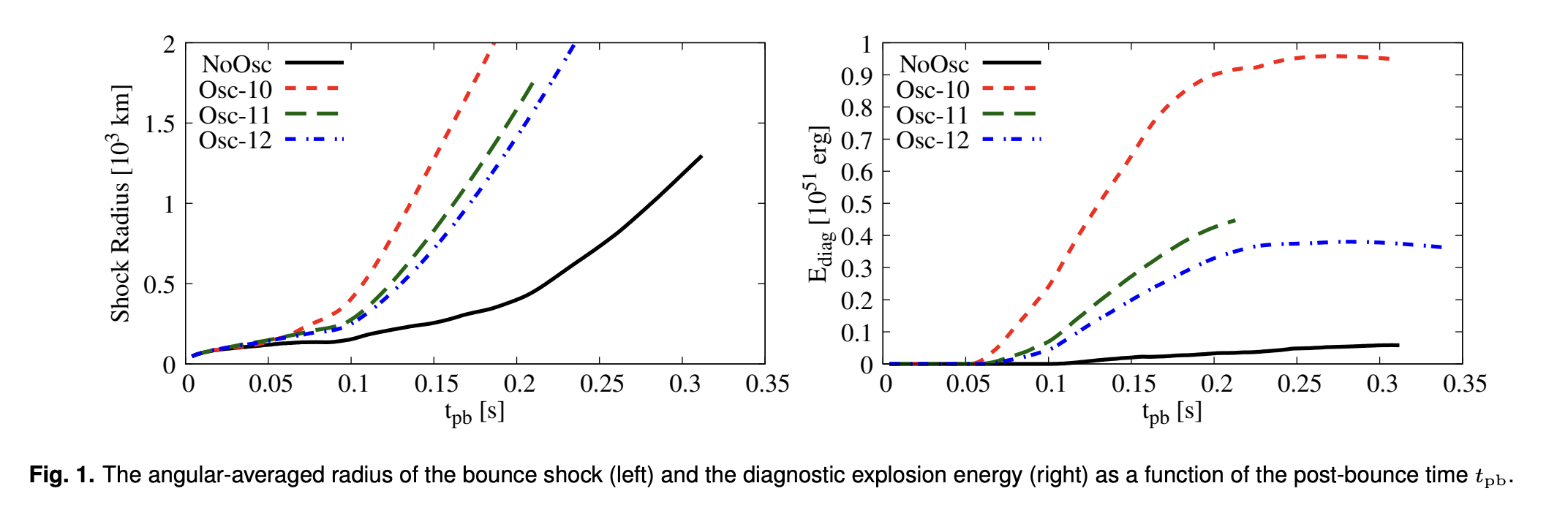
- They perform three-dimensional supernova simulations with a phenomenological treatment of neutrino flavor conversions. They show that the explosion energy can increase to as high as \(\sim 10^{51}\) erg depending on the critical density for the onset of flavor conversions, due to a significant enhancement of the mean energy of electron antineutrinos. Their results confirm previous studies showing such energetic explosions, but for the first time in three-dimensional configurations. In addition, they predict neutrino and gravitational wave (GW) signals from a nearby supernova explosion aided by flavor conversions. They find that the neutrino event number decreases because of the reduced flux of heavy-lepton neutrinos. In order to detect GWs, next-generation GW telescopes such as Cosmic Explorer and Einstein Telescope are needed even if the supernova event is located at the Galactic center. These findings show that the neutrino flavor conversions can significantly change supernova dynamics and highlight the importance of further studies on the quantum kinetic equations to determine the conditions of the conversions and their asymptotic states.
Jan 31
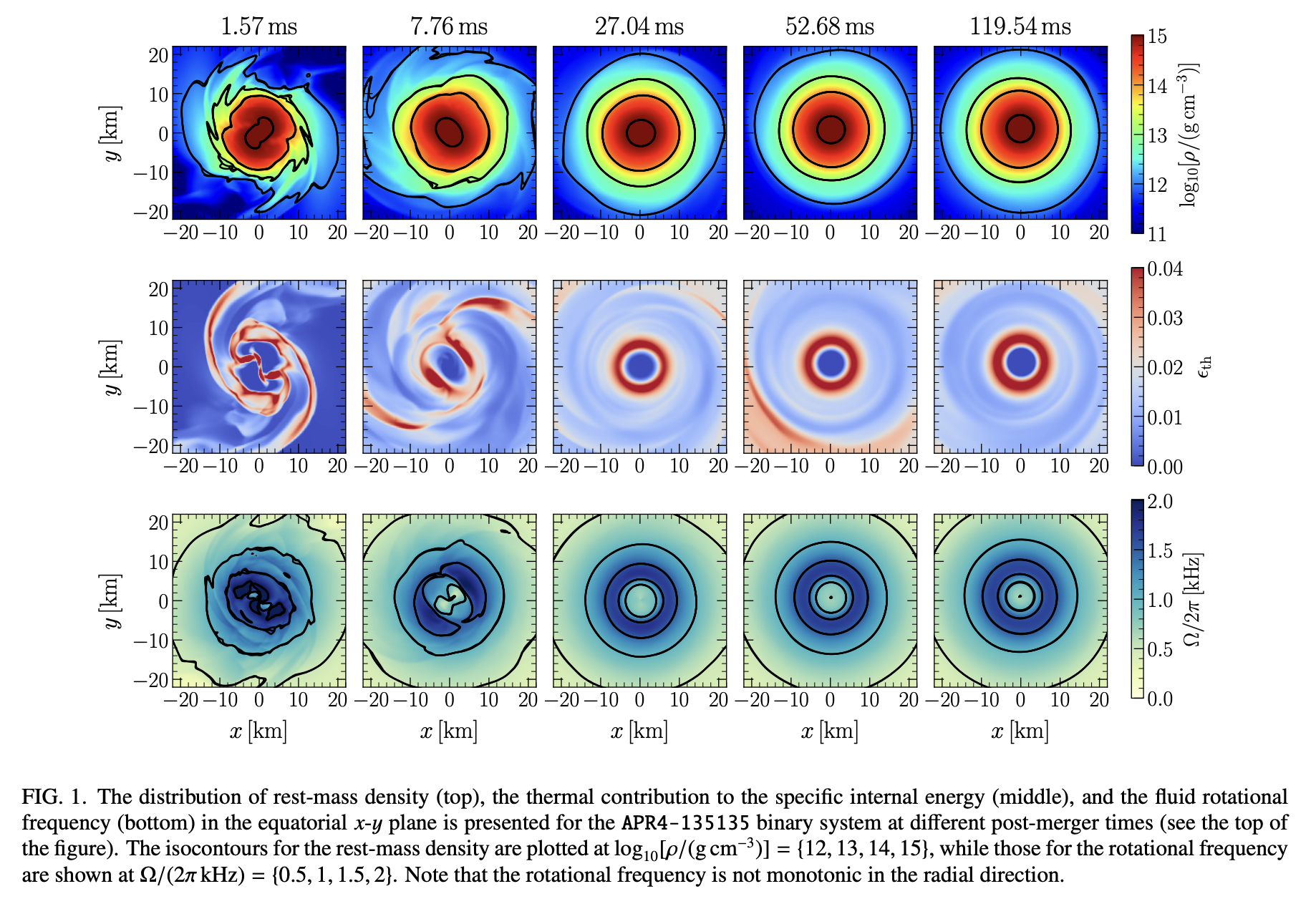
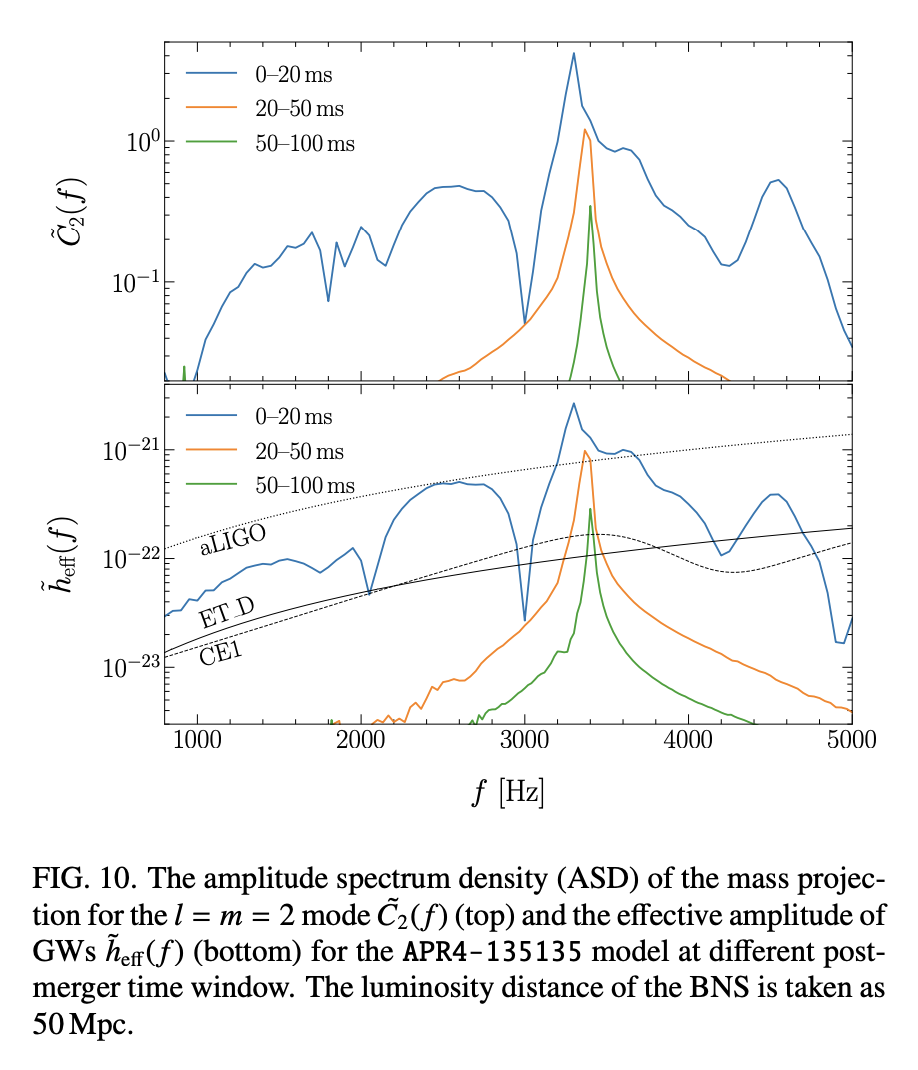
Convective stability analysis of massive neutron stars formed in binary mergers
They perform fully general-relativistic hydrodynamics simulations of binary neutron star mergers over 100 ms post-merger to investigate the dynamics of remnant massive neutron stars (NSs). The focus is mainly on the analysis of convective stability and mode characteristics of the massive NSs. They derive stability criteria for hot, differentially rotating relativistic stars that account for both buoyant and rotational restoring forces, and apply them for the first time to the post-merger massive NSs. Their results show no evidence of large-scale convective instability, as both angle-averaged specific entropy and specific angular momentum increase outward within the massive NSs. Rotational effects significantly enhance stability for local regions that would be otherwise unstable by the Schwarzschild criterion. Additionally, the mode analysis of matter fields and gravitational waves reveals no excitation of inertial modes after the damping of quadrupolar \(f\)-modes in the massive NSs, contrasting with previous studies. As in many previous works, they observe the excitation of an \(m=1\) one-armed mode. However, they also find that the growth of the \(m=1\) mode amplitude after the merger may correlate strongly with the violation of linear momentum conservation, indicating that they cannot reject the possibility that the excitation of the one-armed mode has a numerical origin.
The fate of the merger remnant depends primarily on the total mass and the EOS of NSs. Numerical simulations show that the remnant can either collapse directly into a black hole or form a massive NS. Observing GWs in either scenario can set an upper bound on the threshold mass for prompt collapse and reveals the matter dynamics of the massive NSs. Postmerger simulations of the latter case, spanning a few tens of milliseconds, show a spectrum dominated by a main peak at \(\sim 2-4 \mathrm{kHz}\), with secondary peaks on either side.
Detailed mode analysis indicates that the main peak arises from the \(m=2 f\)-mode, while the secondary peaks may be attributed to the coupling between the \(f\)-mode and quasiradial \(m=0\) mode, or spiral deformations when the massive NS mass is relatively below the collapse threshold. The correlation between the main \(f\)-mode and premerger global properties (such as mass, radius, and tidal deformability) can provide constraints on the EOS of NSs, particularly regarding phase transitions inside NSs. However, potential systematic uncertainties from gravitational theories and thermal effects must also be considered, and need further studies.
Feb
Feb 5
Resonant Locking Between Binary Systems Induced by Gravitational Waves
- The interaction of gravitational waves (GWs) with matter is thought to be typically negligible in the Universe. They identify a possible exception in the case of resonant interactions, where GWs emitted by a background binary system such as an inspiraling supermassive black hole (SMBH) binary causes a resonant response in a stellar-mass foreground binary and the frequencies of the two systems become, and remain, synchronized. They point out that such locking is not only possible, but can significantly reduce the binaries' merger time for \(\mathcal{O}\left(1-10^4\right)\) binaries in the host galaxy of the merging SMBHs of \(10^{9-11} \mathrm{M}_{\odot}\) for standard general relativity and even more either in "wet" SMBH mergers or in certain modified theories of gravity where the inspiral rate is reduced. This could leave an imprint on the period distribution of stellar mass binaries in post-merger galaxies which could be detectable by future GW detectors, such as LISA.
Feb 6
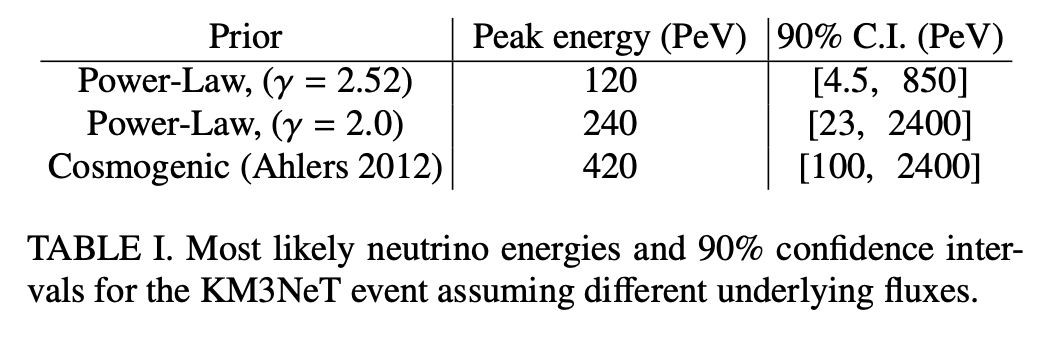
Clash of the Titans: ultra-high energy KM3NeT event versus IceCube data
The extraordinary event observed by KM3NeT, triggering one-third of KM3NeT-ARCA21 photomultiplier tubes, begs the question of its origin. They have shown that, if due to a neutrino interaction, this event would likely point to a neutrino with energies of hundreds of PeV. While this would be the highest energy neutrino observed to date, the lack of such high-energy events in IceCube's data set seems to point to an important tension between these experiments.

Feb 7
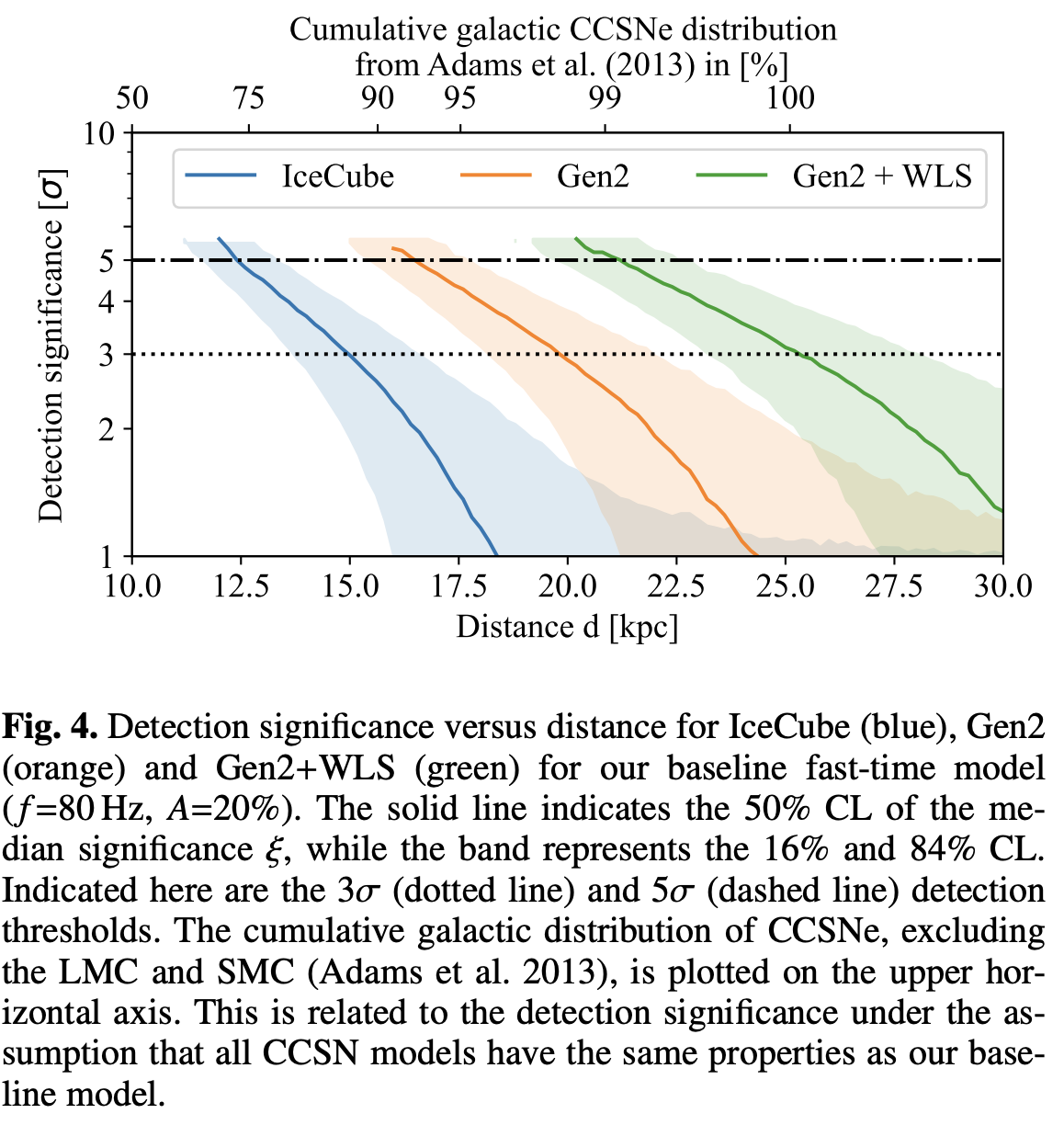
Prospects for detecting generic fast-time features in the neutrino lightcurve of nearby supernovae in neutrino telescopes
Measuring the neutrino flux of the next galactic CCSN with high statistics will reveal crucial information about the fundamental hydrodynamical processes involved in the explosion mechanism of the CCSN, which can manifest as fast-time features in the observed neutrino flux. Fast-time features in the flux are predicted to arise from hydrodynamical instabilities during the accretion phase or fast rotations of the progenitor, with model predictions varying greatly. IceCube and the planned large-scale extension IceCube-Gen 2 would cover a large parameter space of generic fast-time features, with IceCube-Gen 2 having greater sensitivity to fainter modulations and Galactic CCSNe at larger distances.
Wavelength-shifting technology has the potential to improve the sensitivity while constituting a comparatively inexpensive addition to the prospective sensor deployment. IceCube-Gen2, especially if equipped with wavelength shifters, will significantly enhance the detection of fast-time features throughout the Milky Way, allowing for \(>5 \sigma\) detection of modulations as low as \(25 \%\) of the maximum flux, with the frequency and central time of these features reconstructable to within 7 Hz and 17 ms , respectively. The IceCube-Gen2 values demonstrate significant improvements to the detector's sensitivity and reconstruction capabilities compared to IceCube.
Feb 10
Relativistic Gas Accretion onto Supermassive Black Hole Binaries from Inspiral through Merger
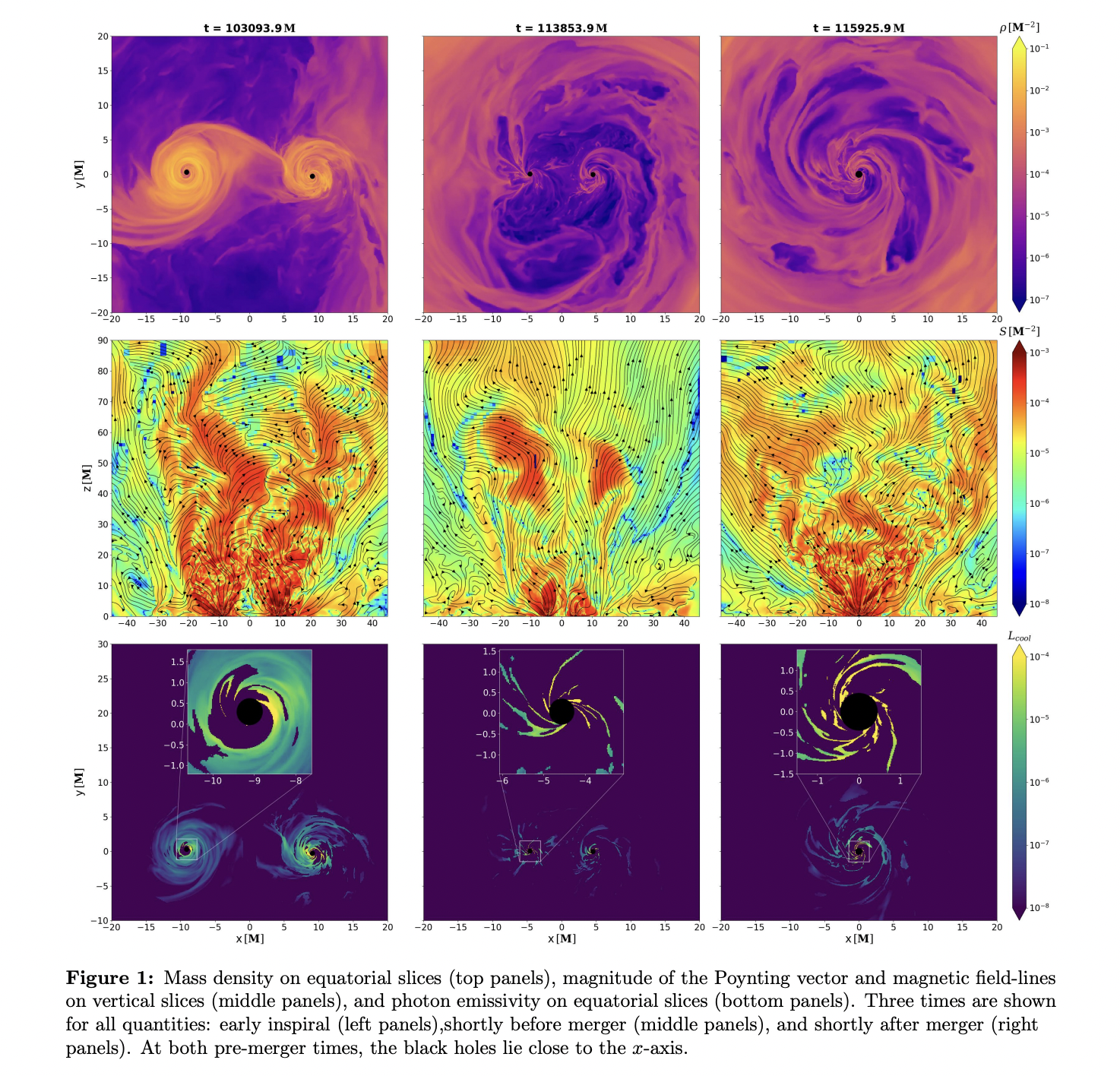
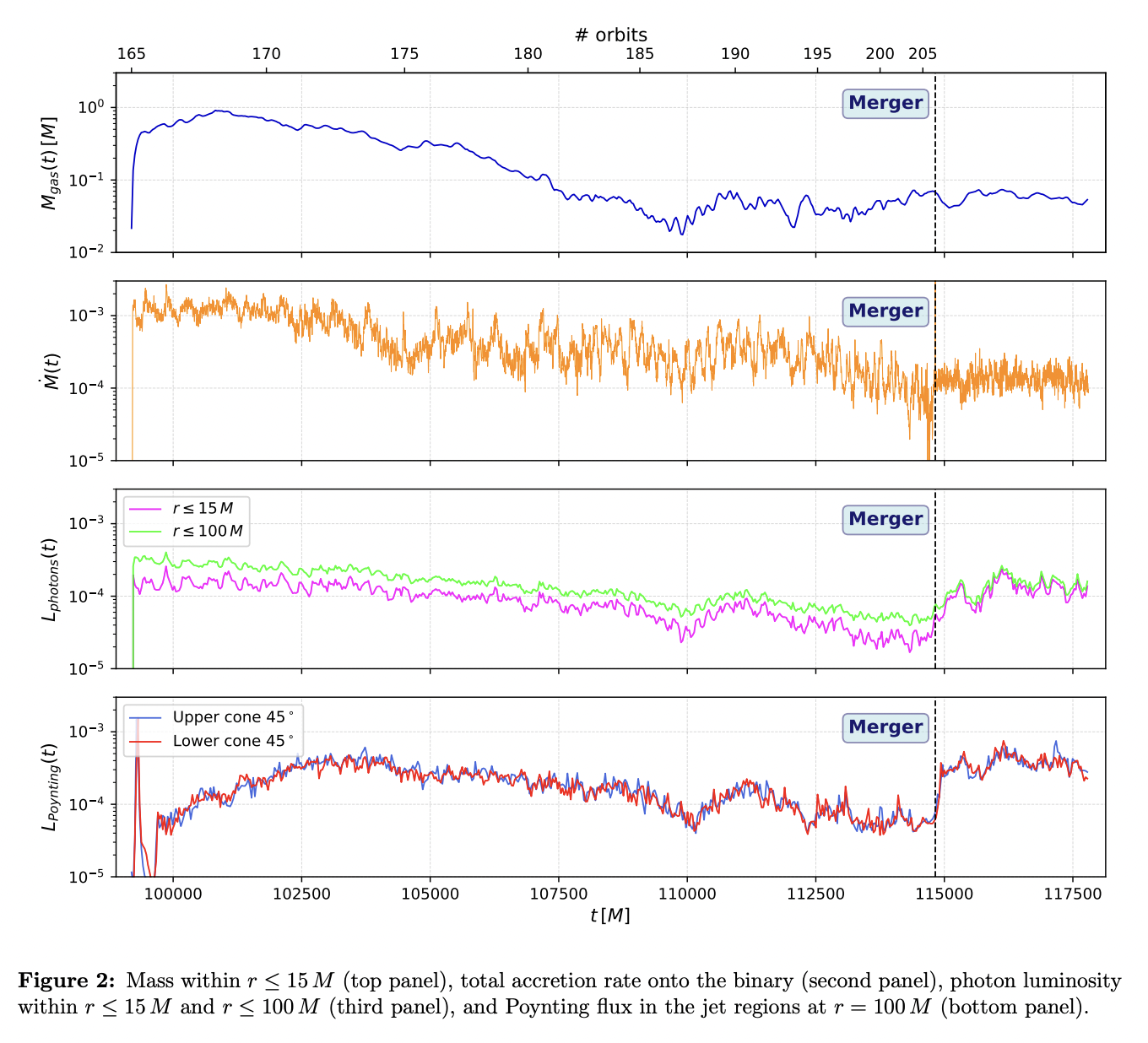
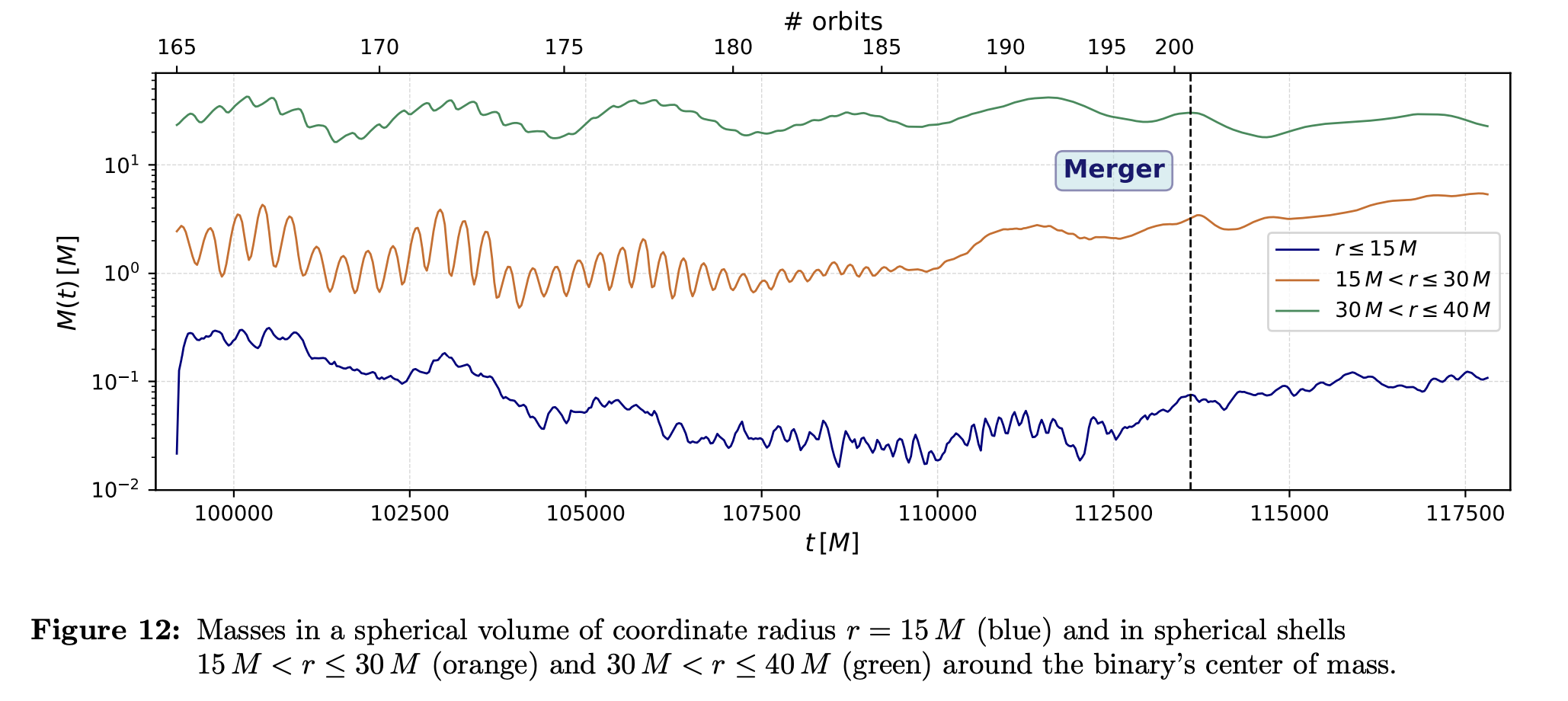
- They have presented the first 3D GRMHD plus numerical relativity simulation that, with realistic initial data, follows the inspiral and merger of a supermassive black hole binary. Starting from a separation of \(20 M\), it used a simple - though effective - treatment for gas cooling through the emission of EM radiation. Although the scope of this paper is limited to the study of an equalmass, non-spinning binary, this work achieves a higher level of physical realism than previous similar simulations documented in the literature.
Feb 11
Building Neutron Stars with the MUSES Calculation Engine
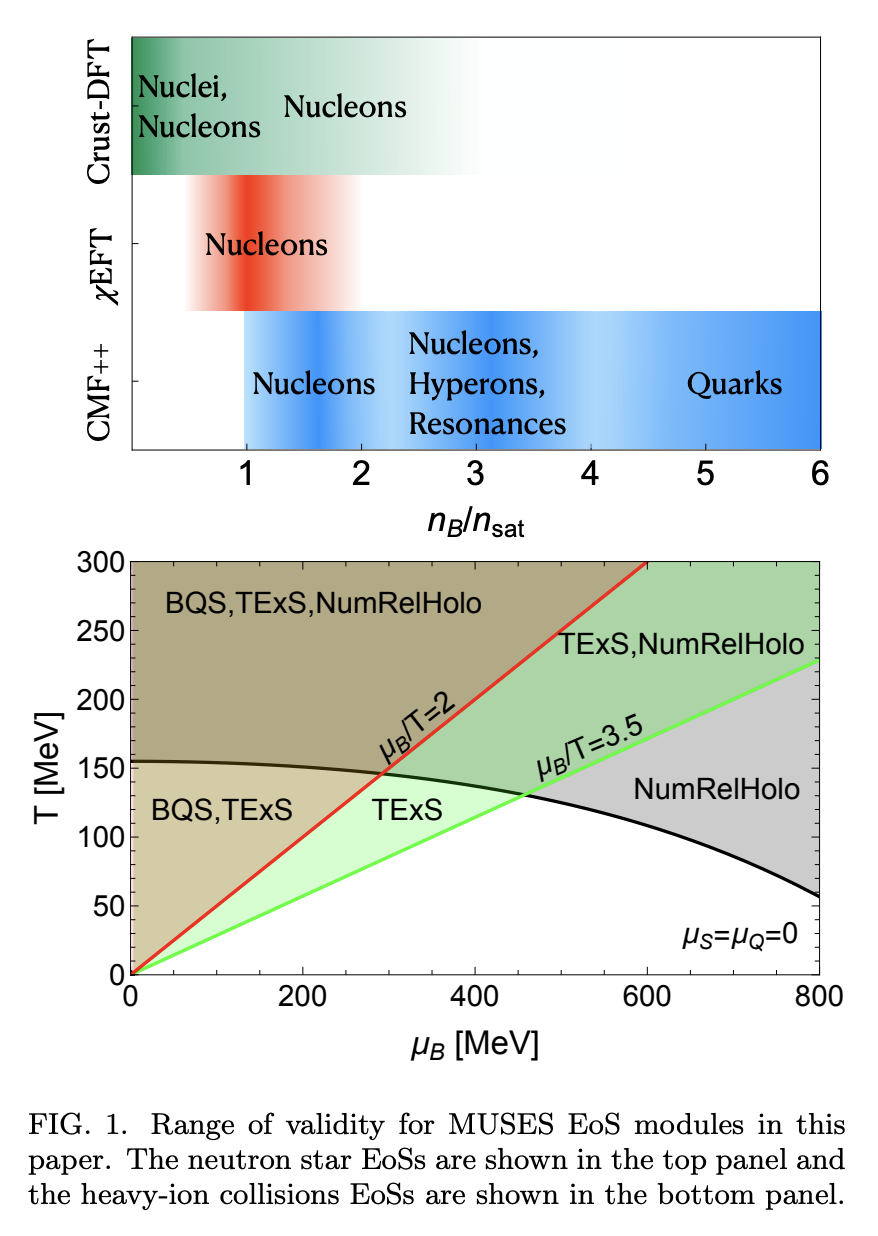
- Exploring the equation of state of dense matter is an essential part of interpreting the observable properties of neutron stars. They present here the first results for dense matter in the zero-temperature limit generated by the MUSES Calculation Engine, a composable workflow management system that orchestrates calculation and data processing stages comprising a collection of software modules designed within the MUSES framework. The modules presented in this work calculate equations of state using algorithms spanning three different theories/models: (1) Crust Density Functional Theory, valid starting at low densities, (2) Chiral Effective Field Theory, valid around saturation density, and (3) the Chiral Mean Field model, valid beyond saturation density. Lepton contributions are added through the Lepton module to each equation of state, ensuring charge neutrality and the possibility of \(\beta\)-equilibrium. They investigate the universality of equation of state-independent relations for our matched stars. Finally, for the first time, they use the Flavor Equilibration module to estimate bulk viscosity and flavor relaxation charge fraction and rates (at low temperature) for Chiral Effective Field Theory and the Chiral Mean Field model.
Feb 12
Observation of an ultra-high-energy cosmic neutrino with KM3NeT
The detection of cosmic neutrinos with energies above a teraelectronvolt (TeV) offers a unique exploration into astrophysical phenomena. Electrically neutral and interacting only by means of the weak interaction, neutrinos are not deflected by magnetic fields and are rarely absorbed by interstellar matter: their direction indicates that their cosmic origin might be from the farthest reaches of the Universe. High-energy neutrinos can be produced when ultra-relativistic cosmic-ray protons or nuclei interact with other matter or photons, and their observation could be a signature of these processes. Here they report an exceptionally high-energy event observed by KM3NeT, the deep-sea neutrino telescope in the Mediterranean Sea, which we associate with a cosmic neutrino detection. They detect a muon with an estimated energy of \(120_{-60}^{+110}\) petaelectronvolts ( PeV ). In light of its enormous energy and near-horizontal direction, the muon most probably originated from the interaction of a neutrino of even higher energy in the vicinity of the detector. The cosmic neutrino energy spectrum measured up to now falls steeply with energy. However, the energy of this event is much larger than that of any neutrino detected so far. This suggests that the neutrino may have originated in a different cosmic accelerator than the lower-energy neutrinos, or this may be the first detection of a cosmogenic neutrino, resulting from the interactions of ultra-high-energy cosmic rays with background photons in the Universe.
Charged-Current (CC) Interaction:
\[\begin{equation*} \nu_\mu+N \rightarrow \mu^{-}+X \end{equation*}\]
or, for an antineutrino:
\[\begin{equation*} \bar{\nu}_\mu+N \rightarrow \mu^{+}+X \end{equation*}\]
where:
- \(N\) is a nucleon (proton or neutron).
- \(X\) represents the remaining hadronic shower from the interaction.
- The outgoing muon inherits a large fraction of the neutrino's energy and continues propagating through the medium.
Collapsar Black Hole Spin Evolution in 3D Neutrino Transport GRMHD Simulations
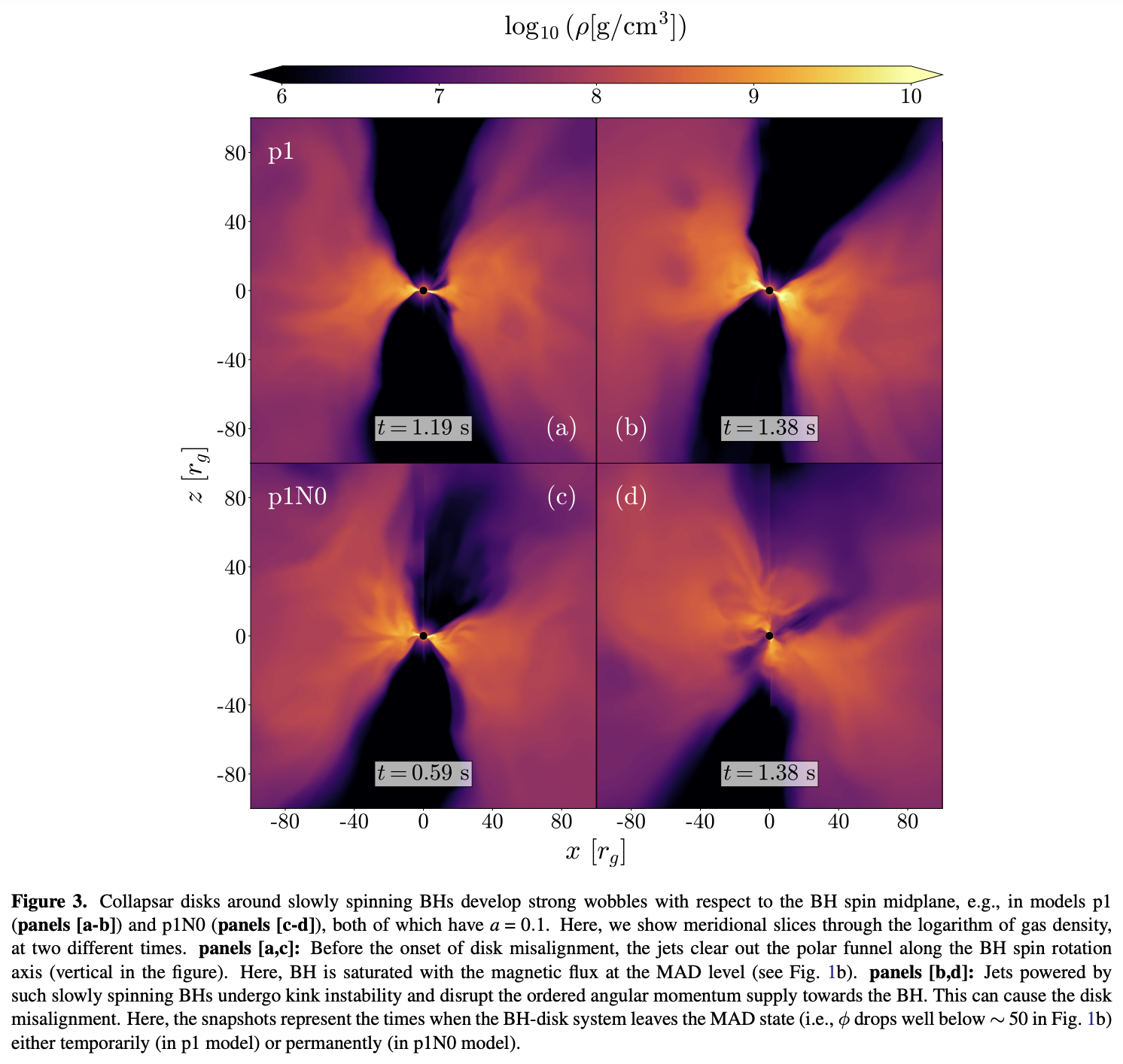
- Collapsars - massive stars whose cores promptly collapse into black holes (BHs) - can power long-duration gamma-ray bursts (LGRBs) via relativistic, collimated, electromagnetically-driven outflows, or jets. Their power depends on the BH magnetic field strength and spin. To survive the infalling stellar material, jets need the central BH to attain dynamically important magnetic fields that can suppress the mass inflow and lead to a magnetically arrested disk (MAD). Previous work found that non-radiative MADs can spin down their BHs to an equilibrium spin, \(a_{\mathrm{eq}}^{\mathrm{nr}}=0.035-0.07\). Such low spins result in extremely low power jets that may struggle to escape out of the star. However, the dense and hot collapsar disks emit neutrinos that cool the disk, reduce its thickness, and increase the angular momentum supply to the BH . Using 3D two-moment neutrino-transport general relativistic magnetohydrodynamic simulations, they show for the first time that successful collapsar jets powered by neutrino-cooled disks still rapidly spin down their BHs , although to a higher \(a_{\mathrm{eq}} \approx 0.13\). This value is consistent with LIGO/Virgo/KAGRA inferred spins, is \(2-4 \mathrm{x}\) higher than for non-radiative MADs, and results in \(4-16 x\) more powerful LGRB jets, which are more capable of drilling out of the progenitor star. This value of \(a_{\text {eq }}\) holds across a wide range of progenitor structures and mass accretion rates, \(\dot{m} \sim(0.1-10) M_{\odot} / \mathrm{s}\). We find that for typical LGRB durations, \(t \gtrsim 30 \mathrm{~s}\), such BHs consume sufficient mass to reach \(a_{\text {eq }} \approx 0.13\) by LGRB's end. However, shorter or lower- \(\dot{m}\) LGRBs can leave behind more rapidly spinning BHs.
Feb 13
Spectral diversity in collisional neutrino-flavor conversion: flavor equipartition or swap
- They investigate collisional neutrino-flavor conversion (CFC) with multi-energy neutrino gases through numerical simulations, demonstrating that the asymptotic states dramatically change depending on unstable modes dominating the system. In one unstable mode, high-energy neutrinos reach a flavor equipartition, but low-energy neutrinos return back to almost their initial states. In contrast, in the other one, rather low-energy neutrinos achieve a full flavor swap, but high-energy neutrinos undergo less flavor conversion. Their result suggests that CFC with flavor swap can become crucial at deeper radii with low electron fraction and requires more detailed theoretical modeling of neutrino quantum kinetics.
Feb 14
Linking Analytic Light Curve Models to Physical Properties of Kilonovae
In binary neutron star mergers, lanthanide-rich dynamical ejecta and lanthanide-poor post-merger ejecta have been often linked to the red and blue kilonova emission, respectively. However, analytic light curve modeling of kilonova often results in the ejecta parameters that are at odds with such expectations. To investigate the physical meaning of the derived parameters, they perform analytic modeling of the kilonova light curves calculated with realistic multi-dimensional radiative transfer based on the numerical relativity simulations. Their fiducial simulations adopt a faster-moving, less massive dynamical ejecta and slower-moving, more massive post-merger ejecta. The results of analytic modeling, however, show that the inferred "red" component is more massive and slower, while the "blue" component is less massive and faster, as also inferred for GW170817/AT2017gfo. This suggests that the parameters derived from light curve modeling with an analytic model do not represent the true configuration of the kilonova ejecta. They demonstrate that the post-merger ejecta contributes to both blue and red emissions: the emission from the post-merger ejecta is absorbed and reprocessed to red emission by the dynamical ejecta with a higher lanthanide fraction. To derive the reliable total ejecta mass, multi-epoch observations in near-infrared wavelengths near their light curve peaks are important.
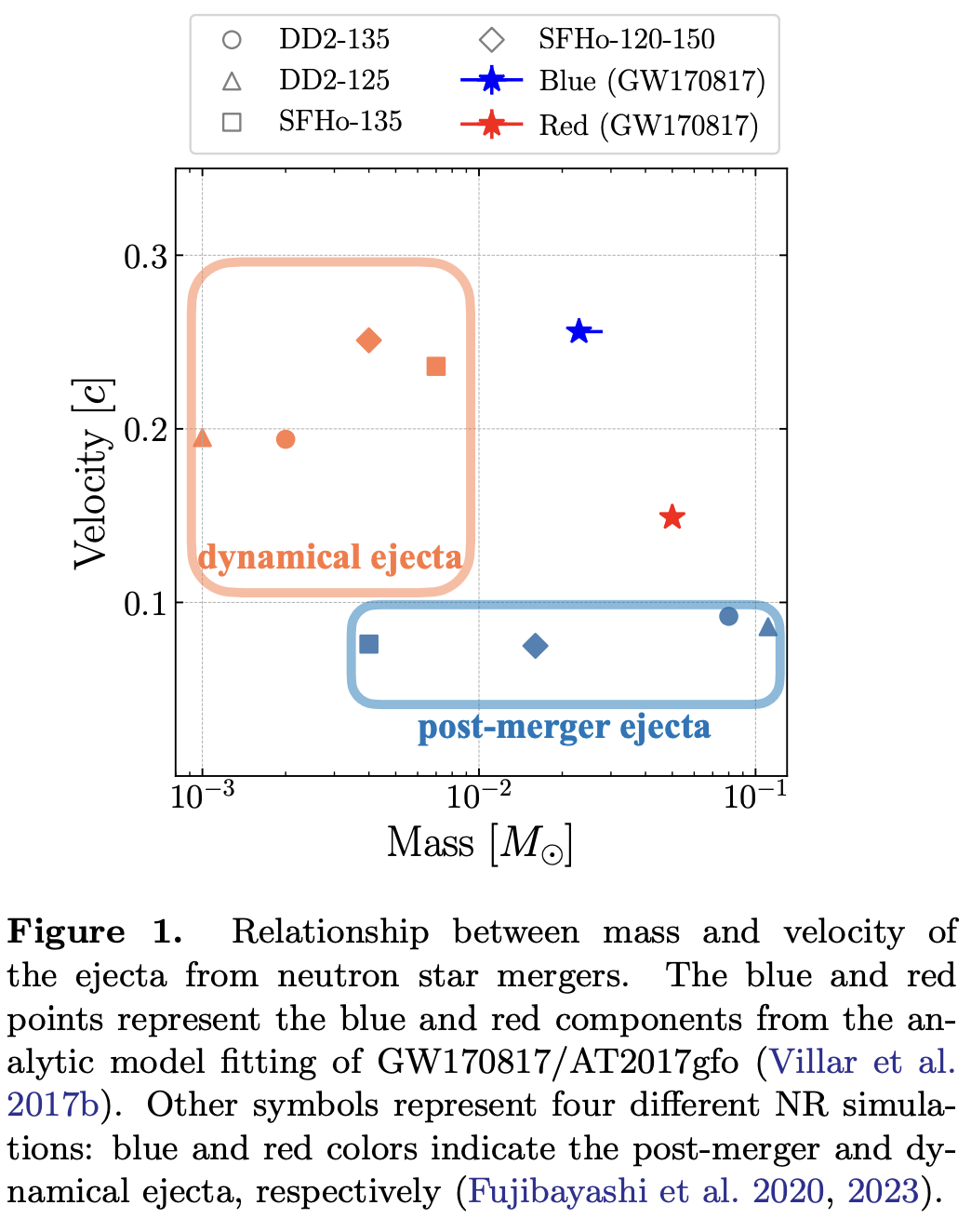
The main reason of this behavior is the reprocessing of photons from post-merger ejecta. In the mergers of a variety of neutron star masses, the post-merger ejecta tend to have a mass comparable to or higher than the dynamical ejecta, and thus, the post-merger ejecta serves as the significant heating source. A part of this emission from the post-merger ejecta is absorbed by the dynamical ejecta, which is mainly distributed in the equatorial plane. As a result, the photon is reprocessed to red emission, which is interpreted as the red component in the analytic light curve model.
Feb 20
Long-term impact of the magnetic-field strength on the evolution and electromagnetic emission by neutron-star merger remnants
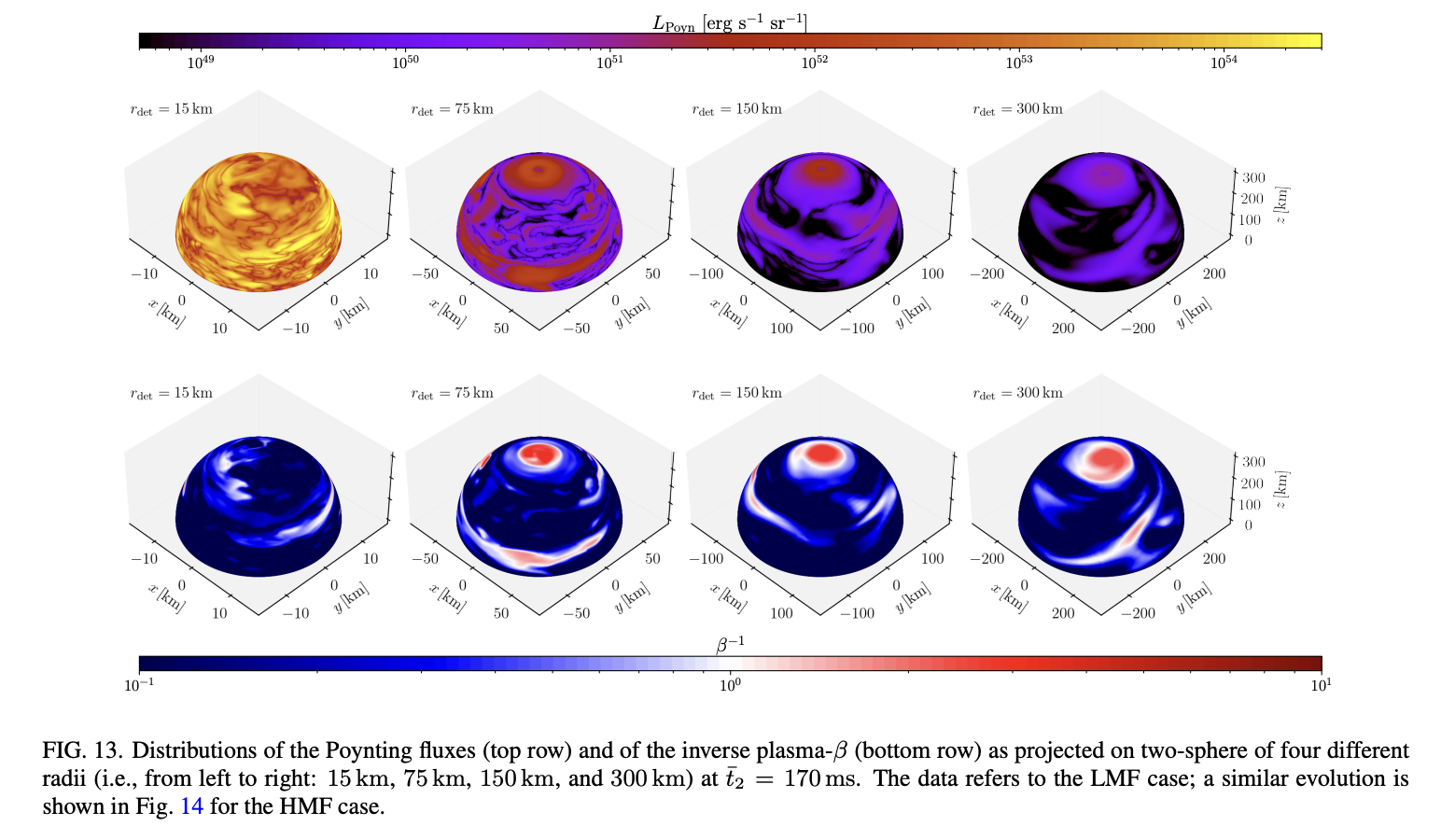
This work developed a hybrid approach that combines, via a hand-off transition, a fully general-relativistic code (FIL) with a more efficient code making use of the conformally flat approximation (BHAC+). They have investigated the impact of the magnetic-field strength on the long-term (i.e., \(\sim 200 \mathrm{~ms}\) ) and high-resolution (i.e., 150 m ) evolutions of the "magnetar" resulting from the merger of two neutron stars with a realistic equation of state. In this way, and for sufficiently large magnetic fields, they observe the weakening or suppression of differential rotation and the generation of magnetic flares in the outer layers of the remnant. These flares, driven mostly by the Parker instability, are responsible for intense and collimated Poynting flux outbursts and mass ejections. This novel phenomenology offers the possibility of seeking corresponding signatures from the observations of short gamma-ray bursts and hence revealing the existence of a long-lived strongly magnetized remnant.
In BHAC+ they used the Conformal Flatness Condition (CFC) to solve the elliptic sector of the Einstein equations, offering an efficient approach to reduce the need for frequent spacetime computations when the spacetime is not highly dynamic.
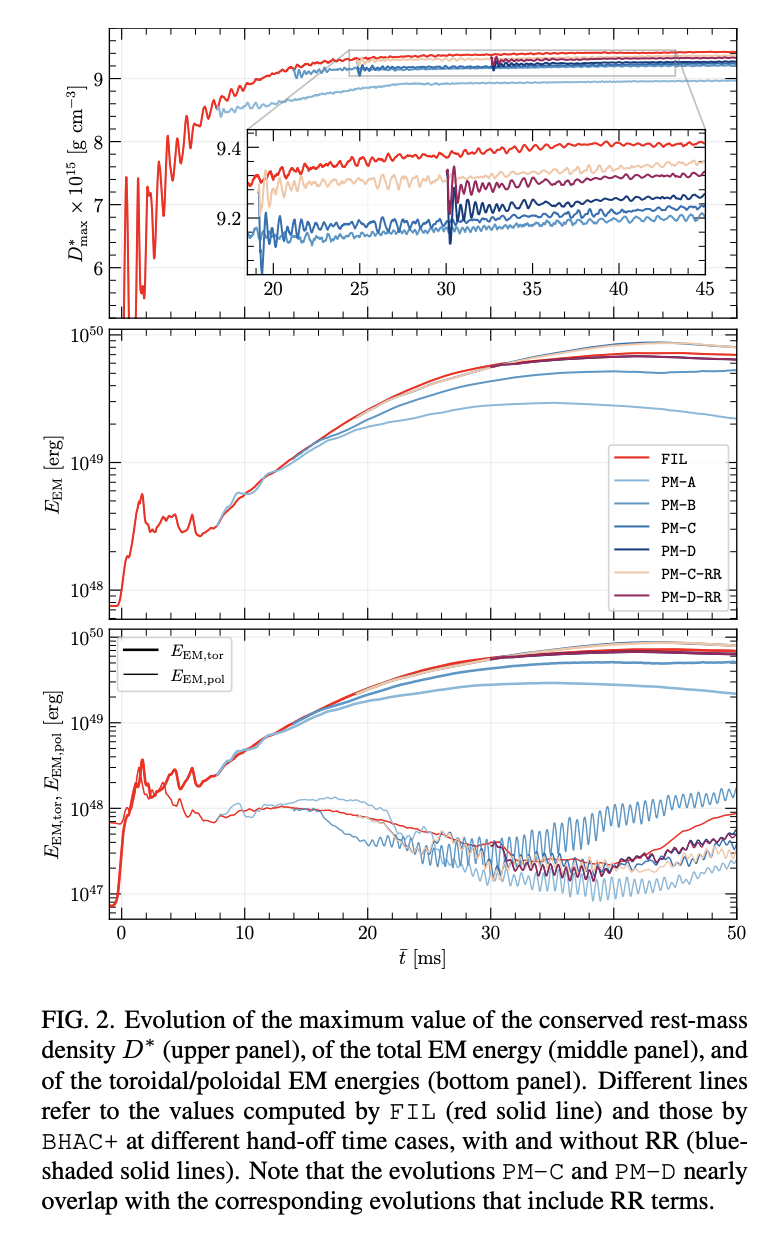
There are caveats about the hand-off times: it seems like the longer it is before the hand-off the better, as tested.
A New Framework for AGN Accretion and Jet Feedback in Numerical Simulations
Long-Term Multidimensional Models of Core-Collapse Supernovae: Progress and Challenges
Feb 22
Gamma-ray bursts and kilonovae from the accretion-induced collapse of white dwarfs
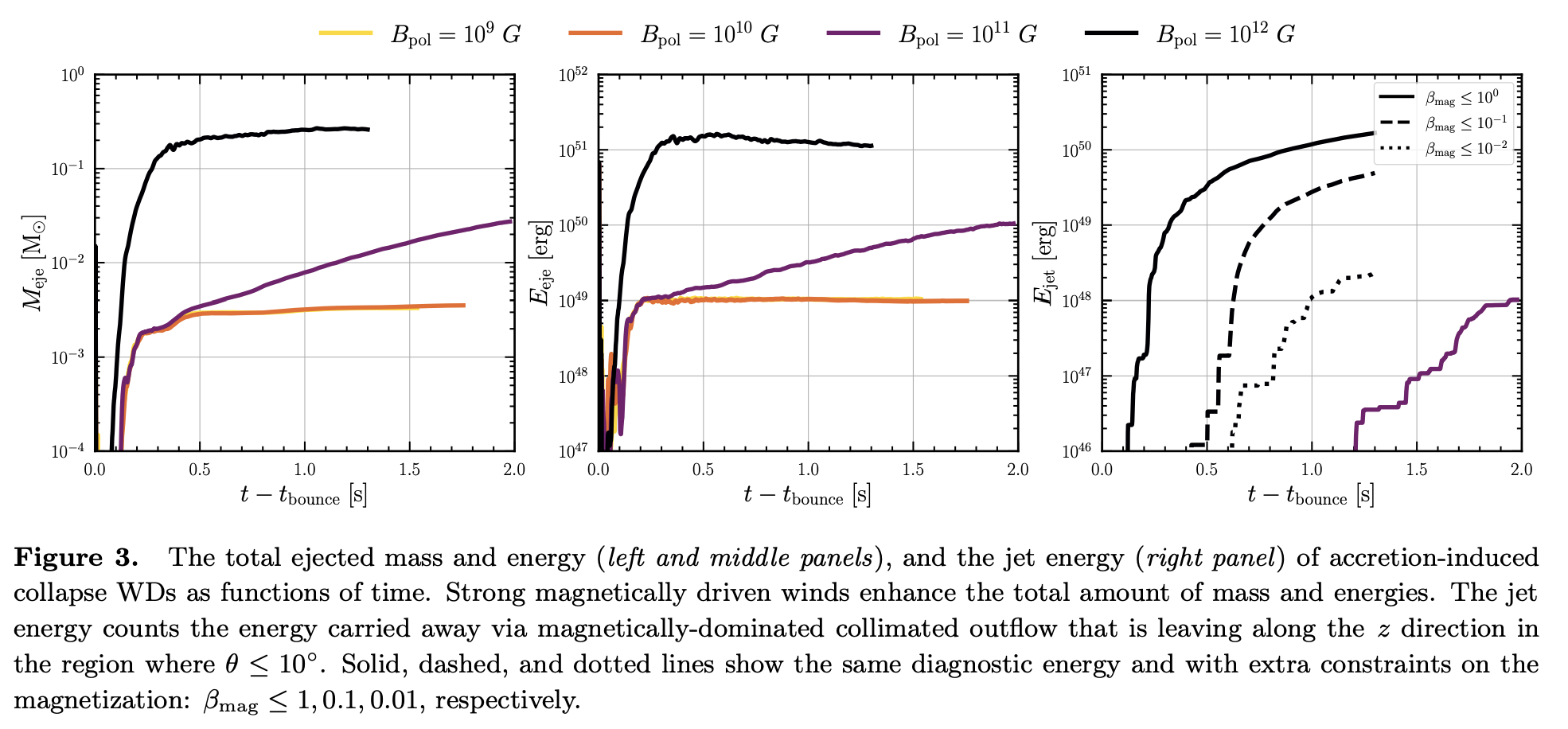
They present the first seconds-long 2D general relativistic neutrino magnetohydrodynamic simulations of accretion-induced collapse (AIC) in rapidly rotating, strongly magnetized white dwarfs (WDs), which might originate as remnants of double-WD mergers. This study examines extreme combinations of magnetic fields and rotation rates, motivated both by the need to address the limitations of 2D axisymmetric simulations and to explore the physics of AIC under rare conditions that, while yet to be observationally confirmed, may be consistent with current theoretical models and account for unusual events. Under these assumptions, the results demonstrate that, if realizable, such systems can generate relativistic jets and neutron-rich outflows with properties consistent with long gamma-ray bursts (LGRBs) accompanied by kilonovae, such as GRB 211211A and GRB 230307A. Longer-duration 3D simulations are needed to fully capture magnetic field amplification, resolve instabilities, and determine the fate of the energy retained by the magnetar at the end of the simulations.
Jets -To assess the possibility of jet formation, they calculate the energy carried away by the magneticallydominated \(\left(\beta_{\text {mag }}<1\right)\) collimated \(\left(\theta \leq 10^{\circ}\right)\) outflow along \(z\)-axis. For the \(B_{\text {pol }}=\) \(10^{11} \mathrm{G}\) case, the jet energy goes beyond \(10^{46} \mathrm{erg}\) about 1.25 s after bounce, reaching \(10^{48} \mathrm{erg}\) by the end of the simulation.

March
Mar 11
Search for gravitational waves emitted from SN 2023ixf
- They present the results of a search for gravitational-wave transients associated with core-collapse supernova SN 2023ixf, which was observed in the galaxy Messier 101 via optical emission on 2023 May 19th, during the LIGO-Virgo-KAGRA 15th Engineering Run. They define a five-day on-source window 4 during which an accompanying gravitational-wave signal may have occurred. No gravitational waves have been identified in data when at least two gravitational-wave observatories were operating, which covered ∼ 14 % of this five-day window. They derive constraints on the gravitational-wave emission mechanism of core-collapse supernovae across a broad frequency spectrum, ranging from 50 Hz to 2 kHz where they assume the gravitational-wave emission occurred when coincident data are available in the on-source window. These constraints are around an order of magnitude more stringent than those obtained so far with gravitational-wave data.
Mar 20
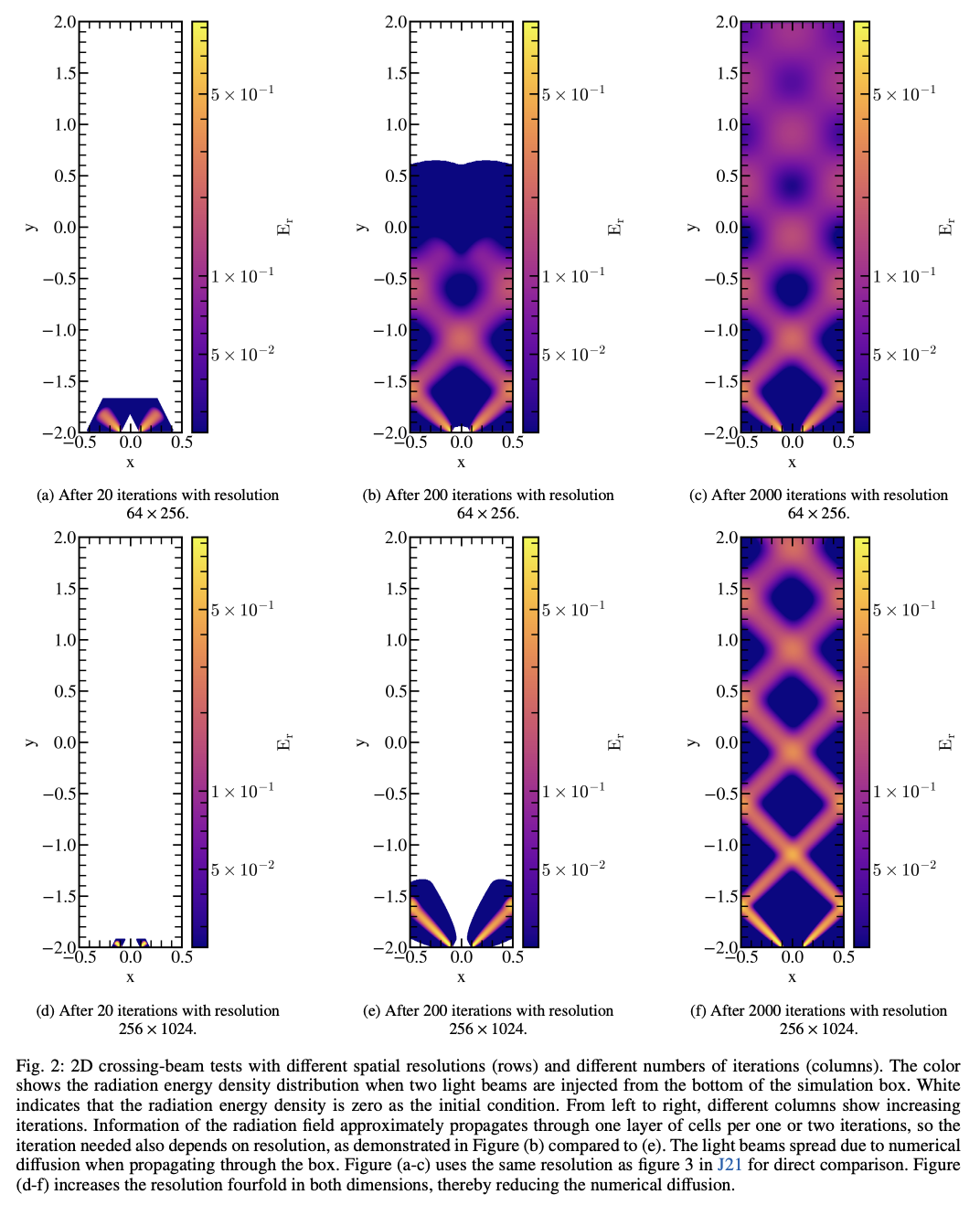
AREPO-IDORT: Implicit Discrete Ordinates Radiation Transport for Radiation Magnetohydrodynamics on an Unstructured Moving Mesh
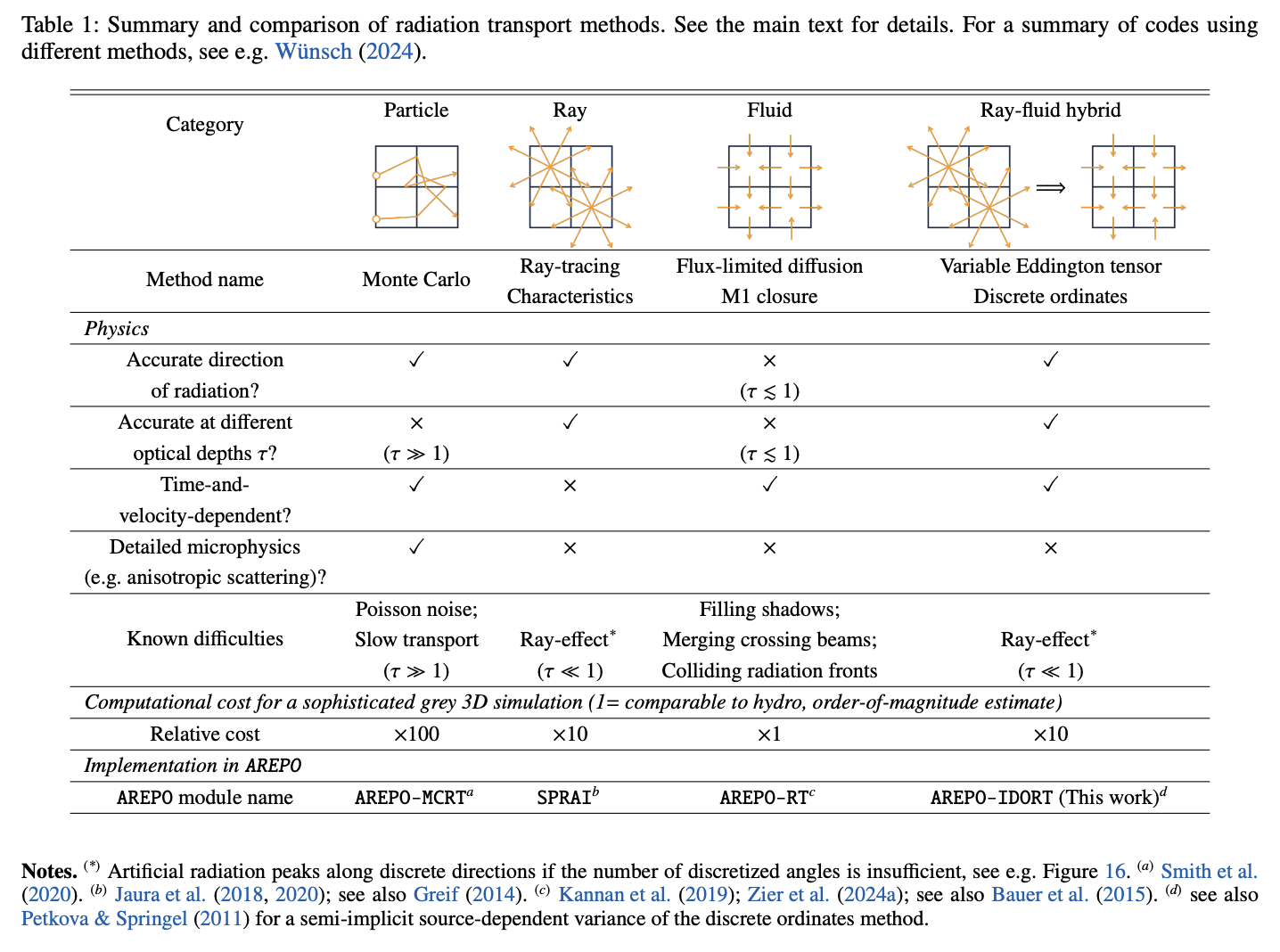
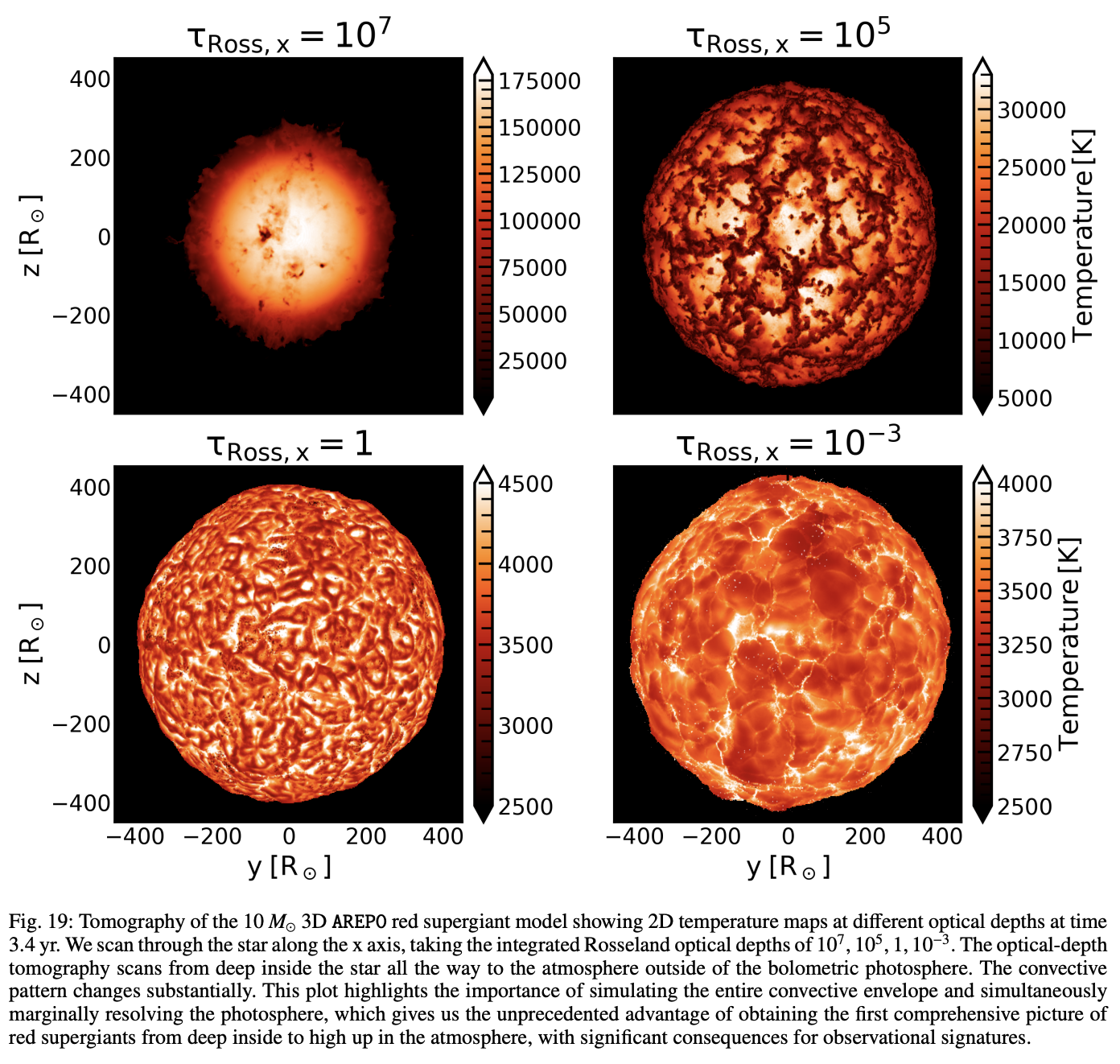
They introduce AREPO-IDORT (Implicit Discrete Ordinates Radiation Transport), a scheme coupled to the explicit magnetohydrodynamic (MHD) solver in the 3D moving-mesh code AREPO. Their discrete ordinates scheme directly solve for the specific intensities along discrete directions. Compared to commonly-used momentbased methods, e.g. flux-limited diffusion or M1 closure, this scheme has the advantage of correctly capturing the direction of radiation in both optically-thick and thin regions. It is based on the scheme by Jiang 2021 for the adaptive mesh refinement code ATHENA++, but they generalize the scheme to support (1) an unstructured moving-mesh, (2) local time-stepping, and (3) general equations of state. They show various test problems that commonly-used moment-based methods fail to reproduce accurately. To apply the scheme to a real astrophysics problem, they also show the first global 3D radiation hydrodynamic simulation of the entire convective envelope of a red supergiant star. They marginally resolve the photosphere, which is a known challenge for global 3D simulations of stars.
They use the same angular discretization as the implementation in ATHENA++ (Davis et al. 2012; Jiang et al. 2014; Jiang 2021). The unit vector along each direction \(\boldsymbol{n}_n=\) \(\left(\left(n_x\right)_n,\left(n_y\right)_n,\left(n_z\right)_n\right)\) is defined with respect to the \((x, y, z)\) coordinates. Each direction is assigned a weight \(w_n\) for integrated quantities. The weights are fixed for all the cells and throughout the simulation. The angular discretization scheme is based on Bruls et al. (1999).
Mar 23
Thermal Radiation Transport with Tensor Trains
Mar 28
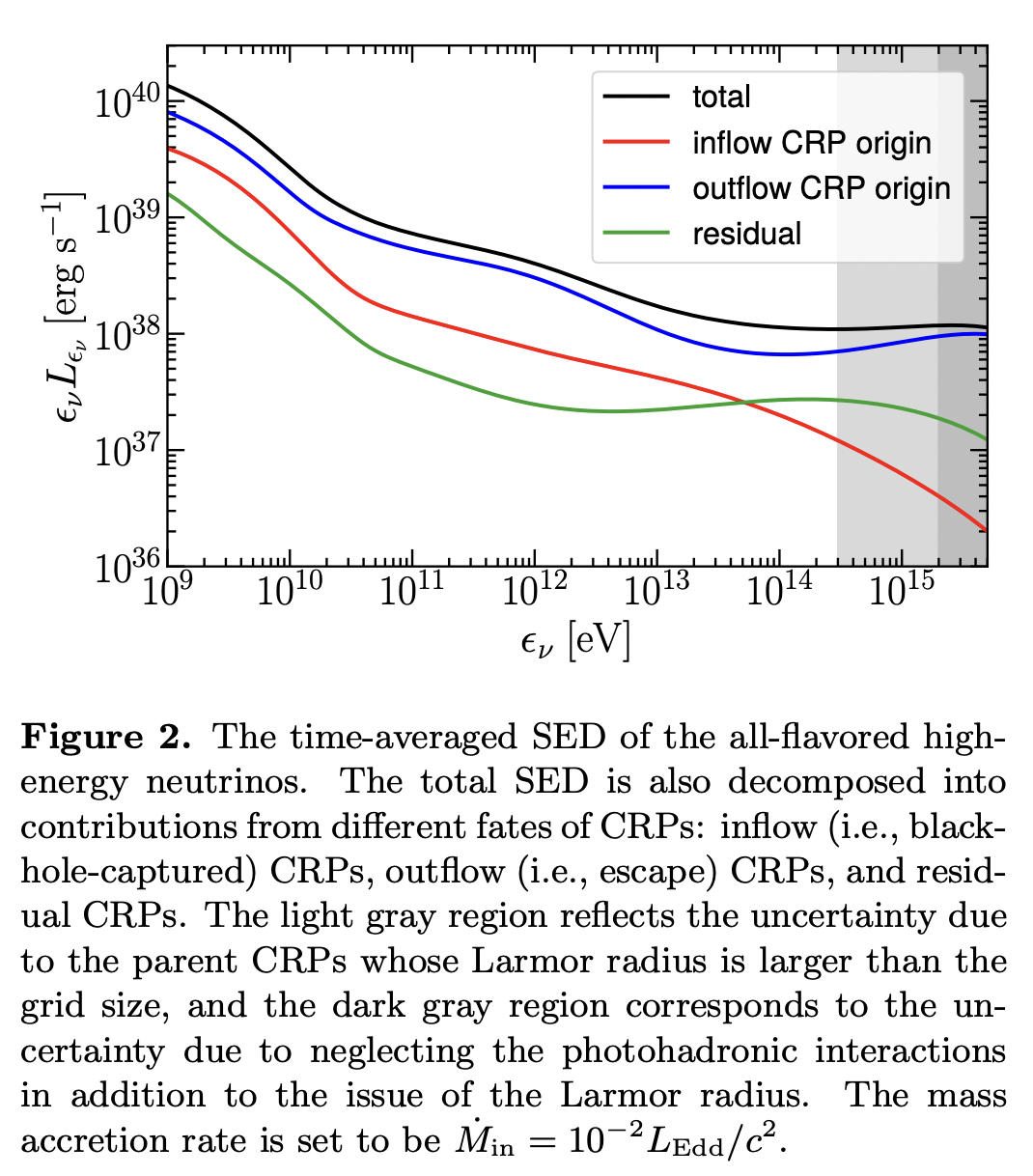
High-Energy Neutrino Emission from a Radiatively Inefficient Accretion Flow with a three-dimensional GRMHD Simulation
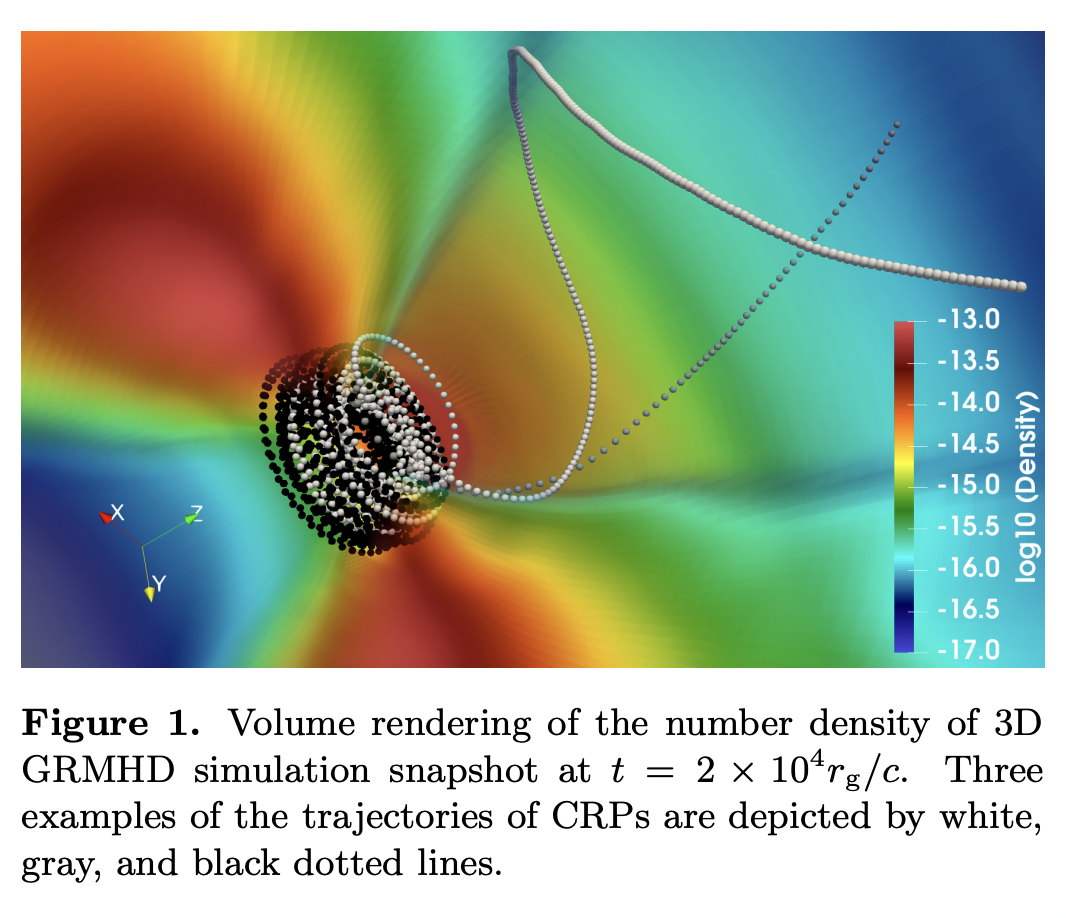
The high-energy particle production in the accretion flow onto black holes can be a key physics to explain the high-energy neutrino background. While the single-zone approximation has been commonly adopted in studies of the high-energy neutrino emission around black holes, the effects of the global plasma structure may be non-negligible. They carry out the first computations of cosmic-ray acceleration and high-energy neutrino emission via the hadronuclear ( \(p p\) ) interaction in global radiatively inefficient accretion flows and outflows around a supermassive black hole, using three-dimensional general relativistic magnetohydrodynamic simulation data.
Mar 31
Angle-dependent in-situ fast flavor transformations in post-neutron star merger disks
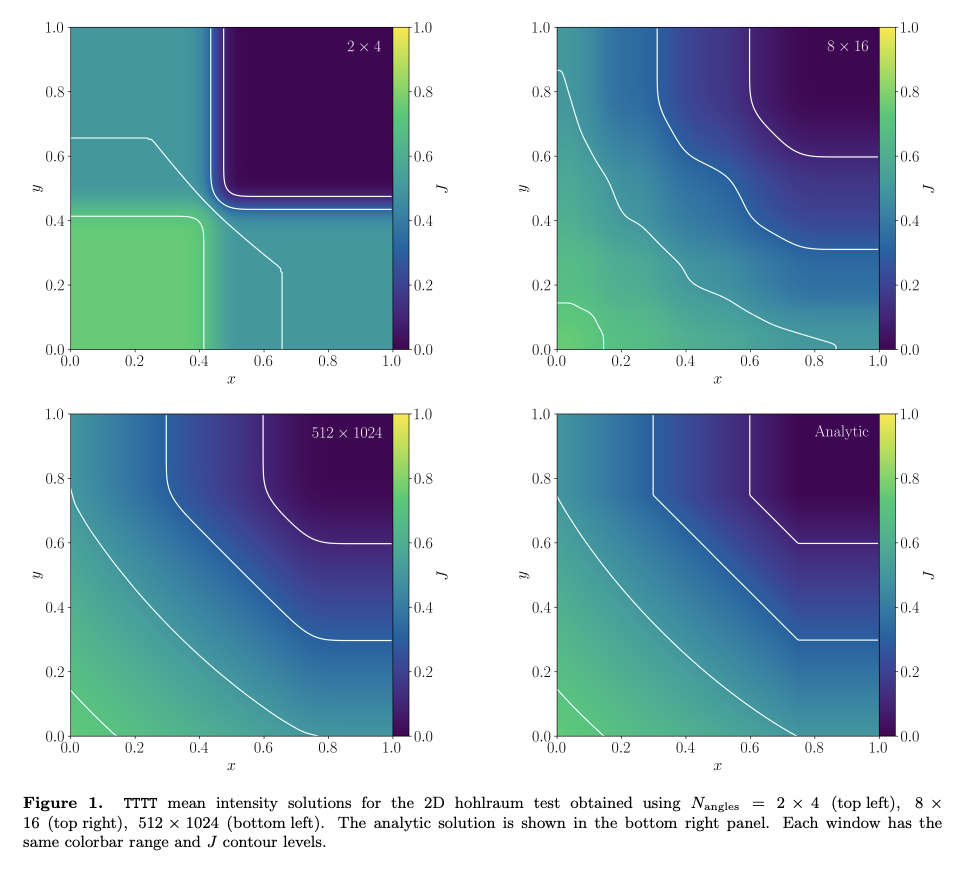
They present a novel tensor network algorithm to solve the time-dependent, gray thermal radiation transport equation. They detail how familiar \(S_N\) algorithms for (gray) thermal transport can be mapped to this TT framework and present several numerical examples testing both the optically thick and thin regimes. The TT framework finds low rank structure and supplies up to \(\simeq 60 \times\) speedups and \(\simeq 1000 \times\) compressions for problems demanding large angle counts, thereby enabling previously intractable \(S_N\) calculations and supplying a promising avenue to mitigate ray effects.
The gray thermal transport equation
\[ \partial_t I+c \mathbf{n} \cdot \nabla I=c(j-\alpha I) \] evolves the frequency-integrated specific intensity \(I=\int_0^{\infty} I_\nu d \nu\), where \(c\) is the speed of light, \(\mathbf{n}\) indicates a unit normal coordinate direction, and \(j\) and \(\alpha\) are the frequency-integrated emissivity and absorptivity, respectively.
April
Apr-7
Binary neutron star merger offsets from their host galaxies II. Short-duration gamma-ray bursts
- Context. The mergers of binary neutron stars (BNSs) and neutron star-black holes (NSBHs) binaries have long been linked to shortduration gamma-ray bursts (SGRBs). However, despite their stellar progenitors, SGRBs are often found outside the stellar light of the host galaxy. This is commonly attributed to supernova kicks, which displace the SGRB progenitors from the original stellar population. Aims. The goal is to use stellar population synthesis models to reproduce and interpret the observed offsets of a statistical sample of SGRBs, using realistic galactic models based on the observed host properties. Methods. They derive the host galaxy potentials from the observed properties on a case-by-case basis, and simulate the galactic trajectories of synthetic BNSs and NSBHs from the BPASS code using three different kick prescriptions. We compare predicted and observed offsets to investigate the impact of velocity kicks, host galaxy types, and host association criteria. Results. The results confirm that the locations of the SGRB population are consistent with the expectations of kicked BNS or BHNS progenitors, implying that such mergers are the dominant (if not only) progenitor system. Predictions for NSBHs provide a significantly worse fit compared to BNSs. They argue that this is likely due to the models missing galaxy evolution, or spurious host associations.
Apr 17
Hot and Dense Matter Equation of State Probability Distributions for Astrophysical Simulations
- They add an ensemble of nuclei to the equation of state for homogeneous nucleonic matter to generate a new set of models suitable for astrophysical simulations of core-collapse supernovae and neutron star mergers. They ensure that the parameters can be varied while preserving thermodynamic consistency and the connection to experimental or observational data, thus providing a probability distribution of the astrophysical hot and dense matter equation of state. They compare our results with those obtained from other available equations of state. While their probability distributions indeed represent a large number of possible equations of state, they cannot yet claim to have fully explored all of the uncertainties, especially with regard to the structure of nuclei in the hot and dense medium.
Apr 23
Cyclic Zoom: Multi-scale GRMHD Modeling of Black Hole Accretion and Feedback
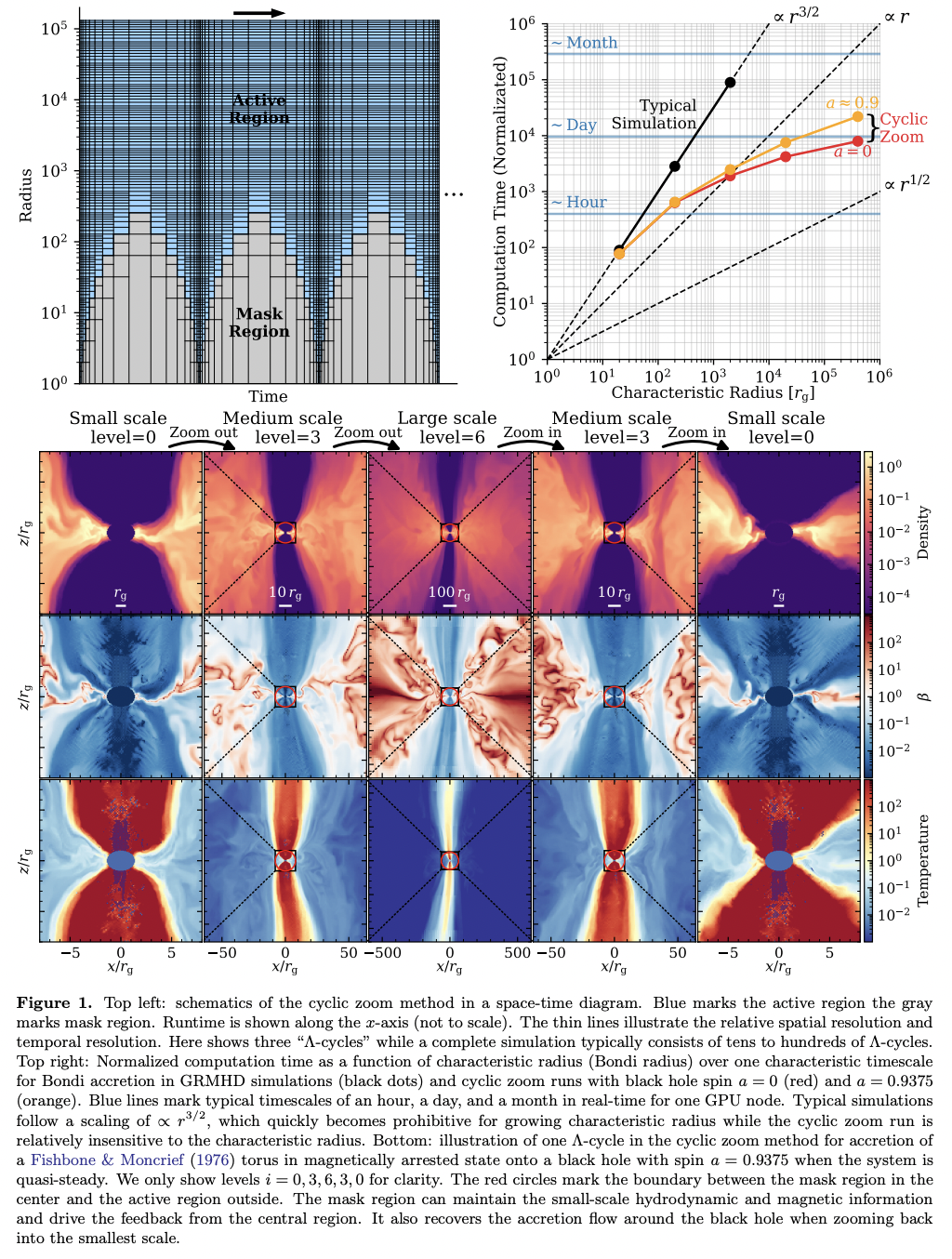
- They present a "cyclic zoom" method to capture the dynamics of accretion flows onto black holes across a vast range of spatial and temporal scales in general relativistic magnetohydrodynamic (GRMHD) simulations. In this method, they cyclically zoom out (derefine) and zoom in (refine) the simulation domain while using a central mask region containing a careful treatment of the coarsened fluid variables to preserve the small-scale physics, particularly the magnetic field dynamics. The method can accelerate GRMHD simulations by \(\gtrsim 10^5\) times for problems with large scale separation. They demonstrate the validity of the technique using a series of tests, including spherically symmetric Bondi accretion, the Blandford-Znajek monopole, magnetized turbulent Bondi accretion, accretion of a magnetized rotating torus, and the long-term evolution of an accreting torus about both Schwarzschild and Kerr black holes. This new method likewise holds significant promise for applications to many other problems that need to cover vast spatial and temporal scales.
Apr 29
Efficient implementation of high-order WENO schemes with sharing function for solving Euler equations
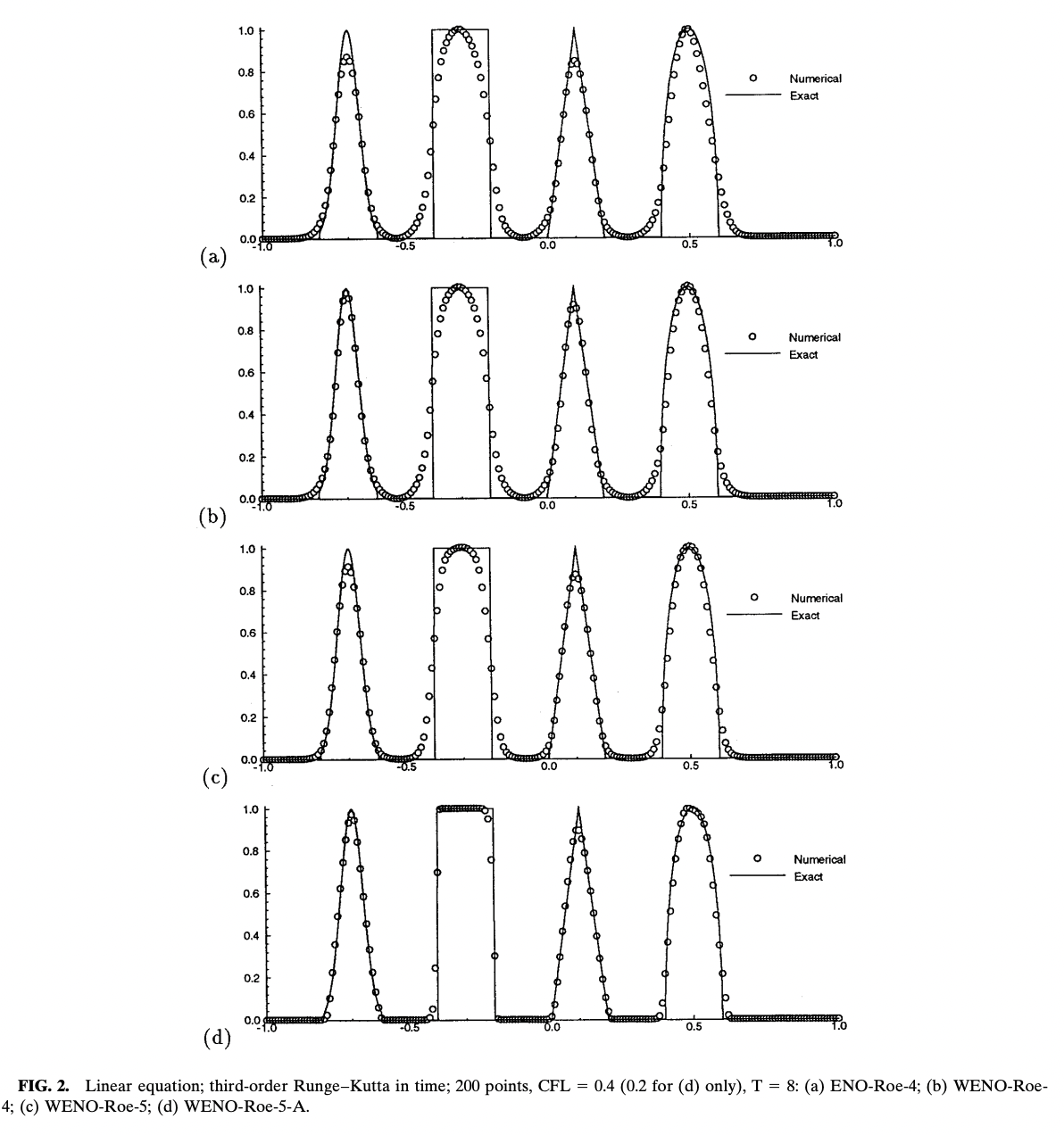
Due to the high-order accuracy and essentially non-oscillatory (ENO) property, the weighted ENO (WENO) schemes have a wide range of successful applications. The component-wise reconstruction WENO (CP WENO) scheme for fluxes or variables has simple formulations but it may produce numerical oscillations near discontinuities when solving the Euler equations. Although the characteristic-wise reconstruction WENO (CH WENO) scheme can reduce such oscillations, it involves too many characteristic projection operations. In this paper, first, they introduced a sharing function to indicate the discontinuities in the Euler equations and then constructed new adaptive characteristic-wise WENO (Ada-WENO) scheme and common-weights WENO (CoWENO) scheme with this function. Several one and two dimensional problems are used to test the performances of Ada-WENO and Co-WENO. Numerical results show that, Ada-WENO can reduce the computational cost of CH WENO while maintaining its oscillation-free property since it only switches from CP WENO to CH WENO near discontinuities, and Co-WENO can reduce the cost and oscillations of CP WENO, but it may still generate few oscillations.
The Euler equations
The one-dimensional Euler equations of the inviscid ideal gas are given by,
\[ \frac{\partial \boldsymbol{U}}{\partial t}+\frac{\partial \boldsymbol{F}}{\partial x}=0 \] in which \(\boldsymbol{U}\) and \(\boldsymbol{F}\) are the conserved variable and the convective flux,
\[ \boldsymbol{U}=\left[\begin{array}{c} \rho \\ \rho u \\ \boldsymbol{E} \end{array}\right] \text {, and } \quad \boldsymbol{F}=\left[\begin{array}{c} \rho u \\ \rho u^2+p \\ u(E+p) \end{array}\right] \] where, \(\rho, u, E\) and \(p\) are density, velocity, total energy and pressure. The equation of state is given by \(E=\frac{p}{\gamma-1}+\frac{1}{2} \rho u^2\) with \(\gamma=1.4\).
For the convective flux \(\boldsymbol{F}\), its Jacobian matrix \(\boldsymbol{A}\) is defined as,
\[ \frac{\partial \boldsymbol{F}(\boldsymbol{U})}{\partial x}=\boldsymbol{A} \cdot \frac{\partial \boldsymbol{U}}{\partial x} . \] where, \(\boldsymbol{A}=\boldsymbol{R} \cdot \boldsymbol{\Lambda} \cdot \boldsymbol{L}\). And \(\boldsymbol{L}\) and \(\boldsymbol{R}\) are the left and right eigenvectors.
With a FVS method one can split the nodal flux \(F_i\) into the positive and negative parts,
\[ \boldsymbol{F}_i=\boldsymbol{F}_i^{+}+\boldsymbol{F}_i^{-} \]
And then calculate the positive and negative numerical fluxes via the WENO-Z scheme to obtain the numerical flux \[ \boldsymbol{F}_{i+1 / 2}=\boldsymbol{F}_{i+1 / 2}^{+}+\boldsymbol{F}_{i+1 / 2}^{-} \]
For CP WENO-Z, one can implement directly on stencil \(S_{i+1 / 2}^{+}=\left(\boldsymbol{F}_{i-2}^{+}, \boldsymbol{F}_{i-1}^{+}, \boldsymbol{F}_i^{+}, \boldsymbol{F}_{i+1}^{+}, \boldsymbol{F}_{i+2}^{+}\right)\) (i.e., implement the WENO reconstruction procedure for each component in \(F_i^{+}\)one by one) to obtain the positive numerical flux,
\[ F_{i+1 / 2}^{C P+}=P^{W E N O-Z}\left(S_{i+1 / 2}^{+}\right) \]
May
May 30
Gravitational-Wave Signatures of Nonstandard Neutrino Properties in Collapsing Stellar Cores
This paper presents a novel multi-messenger approach for probing nonstandard neutrino properties through the detection of gravitational waves (GWs) from collapsing stellar cores and associated supernova explosions. They show that neutrino flavor conversion inside the proto-neutron star (PNS), motivated by physics Beyond the Standard Model (BSM), can significantly boost PNS convection. This effect leads to large-amplitude GW emission over a wide frequency range during an otherwise relatively quiescent GW phase shortly after core bounce. Such a signal provides a promising new avenue for exploring nonstandard neutrino phenomena and other BSM physics impacting PNS convection.
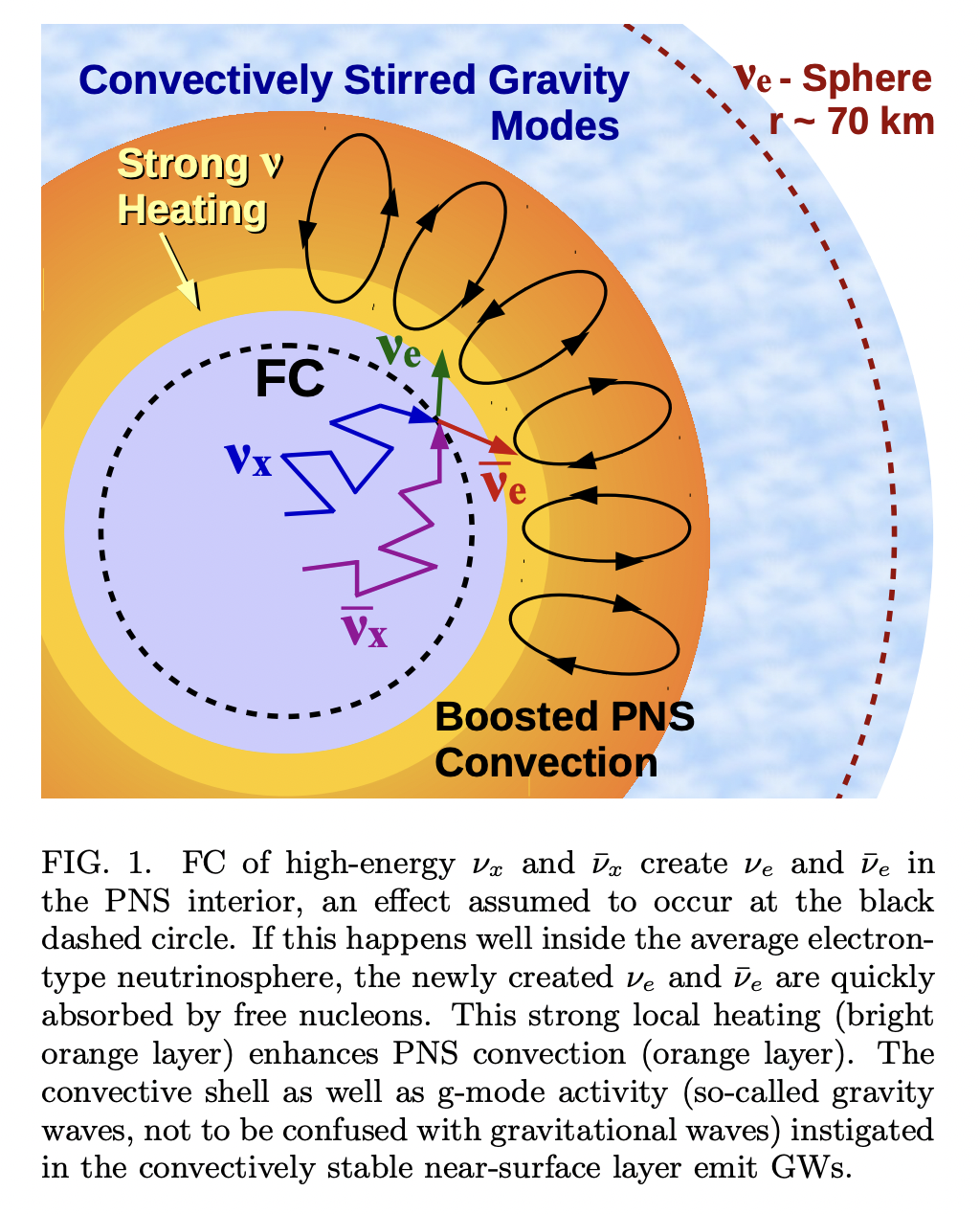
FFCs thus explored are not expected inside the PNS, at least not during the first few 100 ms after bounce. On the other hand, BSM neutrino properties provide several mechanisms for generic FC within the PNS. For instance, nonstandard neutrino selfinteractions ( \(\nu \mathrm{NSSI}\) ) can lead to neutrino flavor equipartition inside the PNS. Likewise, BSM magnetic transition moments for Majorana neutrinos can also cause some sort of equipartition between neutrinos and antineutrinos if there are strong magnetic fields inside the PNS. Such an equipartition could significantly impact the thermodynamics of SNe.
June
June 2
NEoST: A Python package for nested sampling of the neutron star equation of state
- The Nested Equation of State Sampling (NEoST) package is an open-source code that allows users to infer the parameters of the dense matter Equation of State (EoS) in neutron stars via nested sampling. It provides a Bayesian inference framework that compares preexisting EoS models (parameterized or tabulated, for both crust and core) to a variety of user-defined astrophysical input data (real or synthetic), namely mass-radius samples, mass-tidal deformability samples, and mass samples. NEoST can also be used to provide a fast solver for the Tolman–Oppenheimer–Volkoff (TOV) equations for neutron star structure. Moreover, NEoST is able to fully account for a possible dark matter component inside neutron stars, where the dark matter is described by the Nelson et al. (2019) model.
June 16
General-relativistic magnetar magnetospheres in 3D with physics-informed neural networks
- The study addresses the complex structure of magnetar magnetospheres by employing physics-informed neural networks (PINNs) to model three-dimensional configurations in general relativity (GR). Unlike previous axisymmetric models, this approach accounts for realistic surface currents and localized "hotspots," which better reflect observed magnetar phenomena. The PINN solver efficiently handles the non-linear, coupled partial differential equations governing force-free magnetic fields in curved spacetime, offering advantages in scalability and boundary-condition flexibility compared to traditional methods
June 17
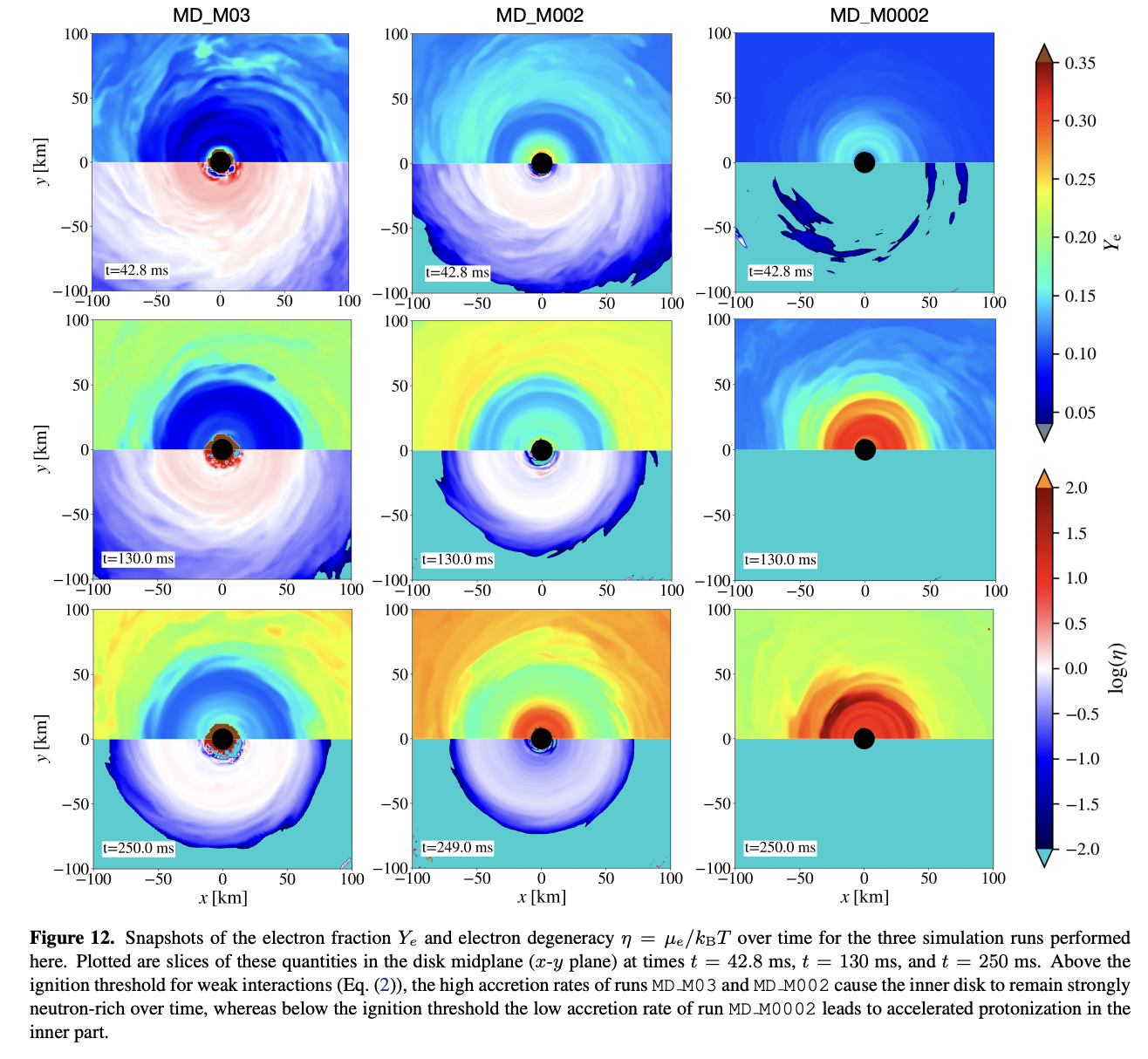
Igniting weak interactions in neutron star postmerger accretion disks
The paper investigates the behavior of accretion disks formed after neutron star mergers and their role in producing heavy elements via the r-process. Using 3D general-relativistic magnetohydrodynamic (GRMHD) simulations with weak interactions and neutrino transport, the authors identify critical thresholds in disk dynamics and nucleosynthetic outcome
The ignition threshold refers to the critical accretion rate in neutron star postmerger accretion disks at which weak interactions—such as neutrino emission and absorption—become dynamically significant. This threshold determines whether the disk can efficiently cool via neutrino emission, which in turn affects the disk’s evolution, outflow properties, and the nucleosynthesis of heavy elements
Key Findings
- Ignition threshold: Weak interactions become significant at accretion rates of \(\sim 10^{-3} \mathrm{M} \odot / \mathrm{s}\), creating two distinct regimes:
- Neutrino-cooled regime (above threshold):
- Efficient neutrino cooling maintains disk stability
- Produces full r-process elements matching solar abundances
- Ejects \(\leq 40 \%\) disk mass at velocities \(\sim 0.1-0.15 \mathrm{c}\)
- Advection-dominated regime (below threshold):
- Reduced neutrino cooling leads to stronger outflows
- Ejects \(\geq 60 \%\) disk mass at higher velocities ~0.1-0.2c
- Suppresses light r-process elements while potentially creating actinideboosted stars
June 19
Direct Inference of Nuclear Equation-of-State Parameters from Gravitational-Wave Observations
- The observation of neutron star mergers with gravitational waves (GWs) has provided a new method to constrain the dense-matter equation of state (EOS) and to better understand its nuclear physics. However, inferring nuclear microphysics from GW observations necessitates the sampling of EOS model parameters that serve as input for each EOS used during the GW data analysis. The sampling of the EOS parameters requires solving the Tolman-Oppenheimer-Volkoff (TOV) equations a large number of times – a process that slows down each likelihood evaluation in the analysis on the order of a few seconds. Here, they employ emulators for the TOV equations built using multilayer perceptron neural networks to enable direct inference of nuclear EOS parameters from GW strain data. These emulators can rapidly solve the TOV equations, taking in EOS parameters and outputting the associated tidal deformability of a neutron star in only a few tens of milliseconds. They implement these emulators in PyCBC to directly infer the EOS parameters using the event GW170817, providing posteriors on these parameters informed solely by GWs. They benchmark these runs against analyses performed using the full TOV solver and find that the emulators achieve speed ups of nearly two orders of magnitude, with negligible differences in the recovered posteriors.
- The measurement of tidal deformability Λ from GW strain data allows us to place constraints on the EOS. For example, the original constraint on the tidal deformability from GW170817 was Λ < 800. This constraint is stringent enough to rule out a number of EOS as it requires the EOS to be soft. However, these analyses have only constrained the overall EOS in the pressuredensity space. In contrast, the nuclear microphysics is encoded in a set of EOS parameters. Extracting information on these parameters from GW inferences of the EOS is difficult and may lead to systematic uncertainties; for example, due to limited resolution of pregenerated EOS sets. Furthermore, the EOS parameters might exhibit degeneracies that are difficult to disentangle after an inference run, and implementing different Bayesian priors on these parameters is difficult a posteriori. To understand and alleviate some of these concerns, we would like to directly sample the microphysical parameters that describe the EOS in analyses of GW data.
July
July 6
Black Hole - Neutron Star Binary Mergers: The Impact of Stellar Compactness
- Recent gravitational wave observations include possible detections of black hole - neutron star binary mergers. As with binary black hole mergers, numerical simulations help characterize the sources. For binary systems with neutron star components, the simulations help to predict the imprint of tidal deformations and disruptions on the gravitational wave signals. In a previous study, we investigated how the mass of the black hole has an impact on the disruption of the neutron star and, as a consequence, on the shape of the gravitational waves emitted. We extend these results to study the effects of varying the compactness of the neutron star. We consider neutron star compactness in the 0.123 to 0.2 range for binaries with mass ratios of 3 and 5. As the compactness and the mass ratio increase, the binary system behaves during the late inspiral and merger more like a black hole binary. For the case with the highest mass ratio and most compact neutron star, the gravitational waves emitted, in terms of mismatches, are almost indistinguishable from those by a binary black hole. The disruption of the star significantly suppresses the kicks on the final black hole. The disruption also affects, although not dramatically, the spin of the final black hole. Lastly, for neutron stars with low compactness, the quasi-normal ringing of the black hole after the merger does not show a clean quasi-normal ringing because of the late accretion of debris from the neutron star.
August
Aug 29
Investigating the Impact of Higher-Order Phase Transitions in Binary Neutron-Star Mergers
This paper explores how the order of phase transitions—particularly second and third order—between hadronic and quark matter affects the dynamics and gravitational wave signals from binary neutron star (BNS) mergers.
The authors introduce a method to create EoSs that feature not just first-order quark deconfinement transitions, but also higher-order (second and third) phase transitions, through a process called percolation. The EoSs are constructed by modifying existing microscopic models (from the CompOSE database) using polynomial interpolation, controlling the smoothness (order) of the phase transition between hadron and quark phases.
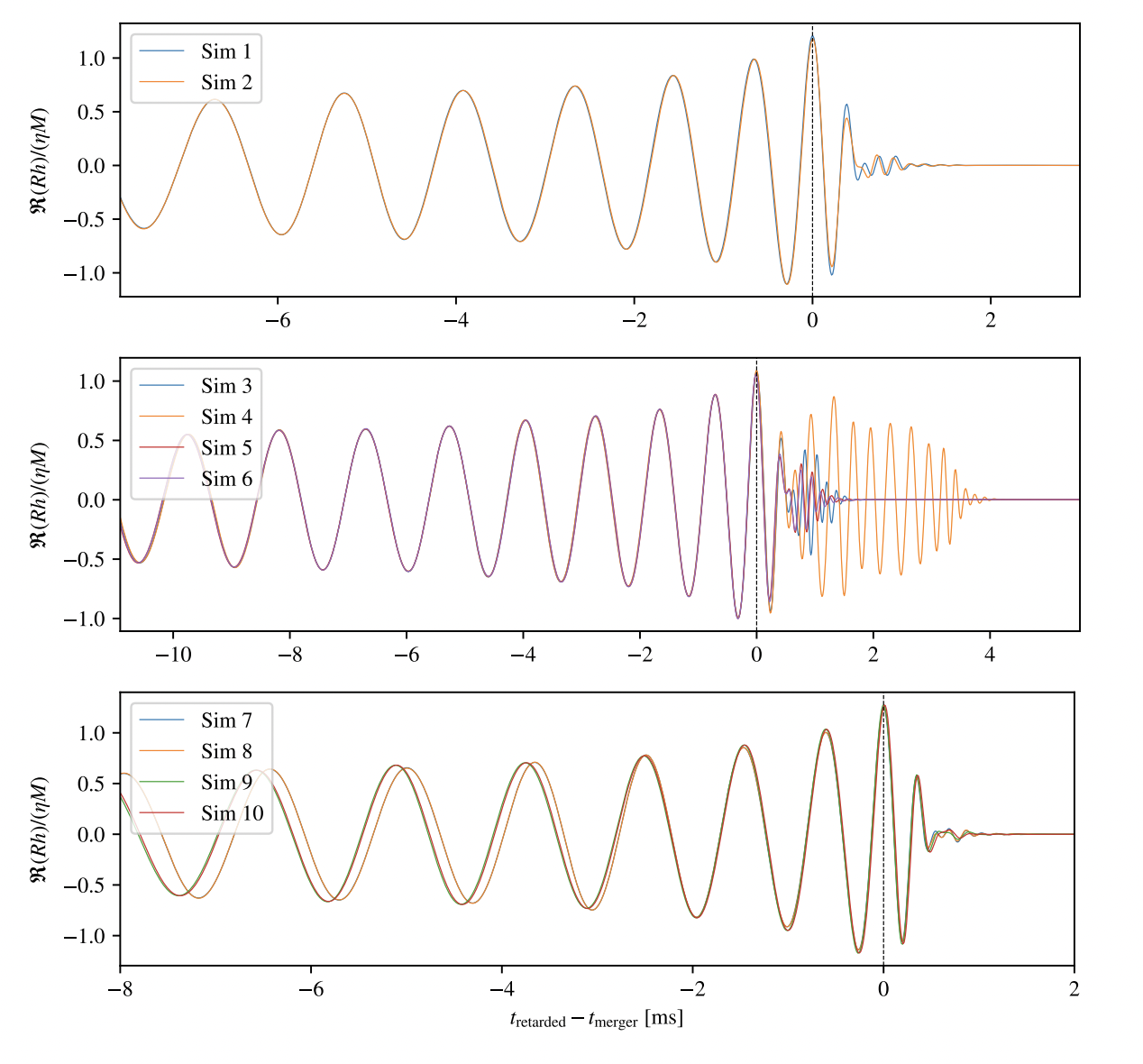
Overall, the difference in GWs only appear clearly in post-merger, for one of the EoSs chosen.
Aug 31
On the difficulty of capturing the distribution function of neutrinos in neutron star merger simulations
This work shows that capturing the full neutrino distribution function in merger simulations is currently computationally prohibitive. Existing methods are sufficient for some key observables but inadequate for advanced neutrino-matter physics. Progress requires both new algorithms (packet weighting, smoothing) and increased computational resources to enable more accurate modeling of neutrinos in neutron star mergers. Maybe M1+Monte Carlo hybrid approach would be the future.
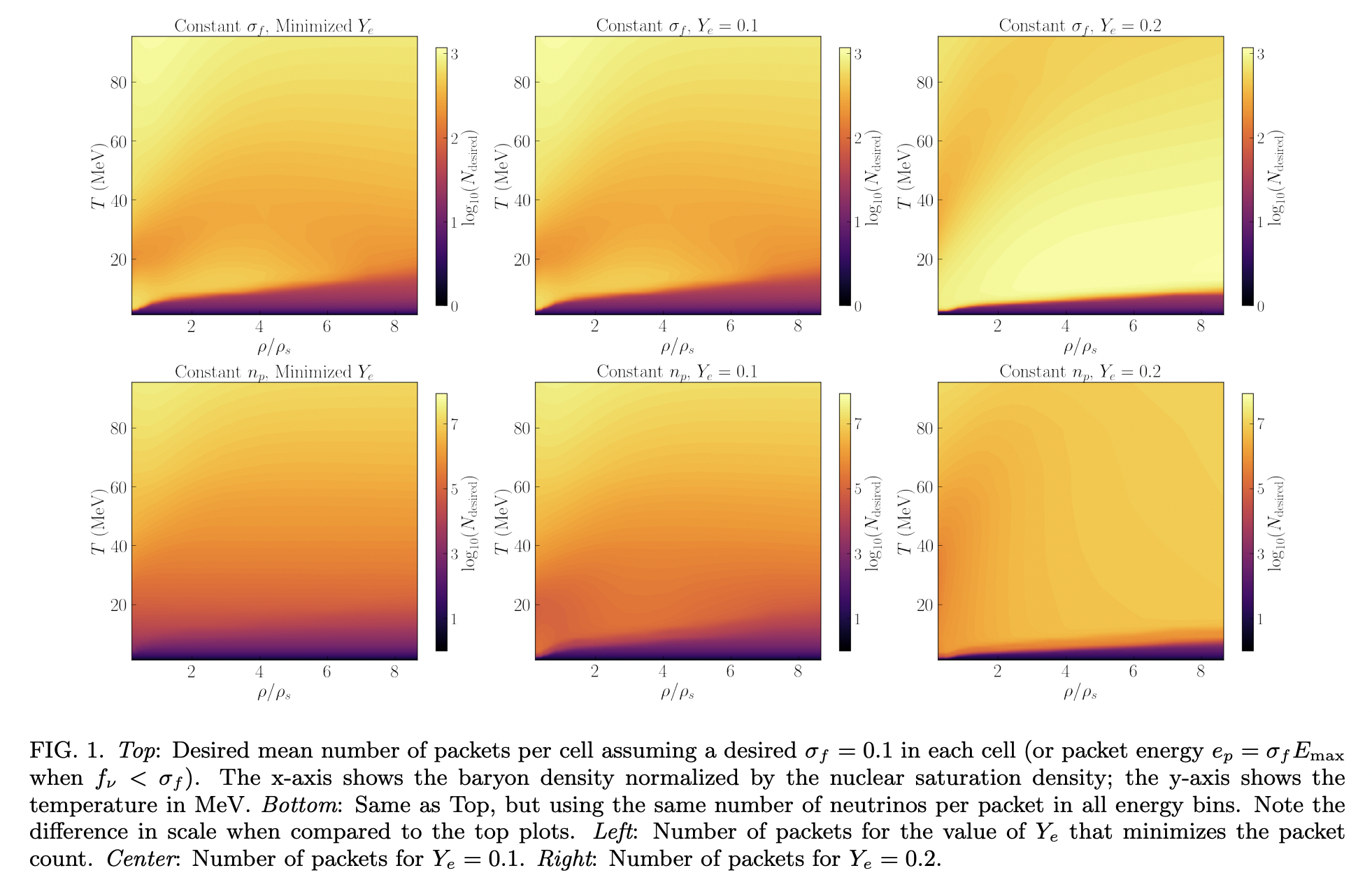
Even if only a coarse estimate of fν*f**ν* (with error σf∼0.1*σ**f*∼0.1) is desired, this would require much larger numbers of packets and/or smarter smoothing and weighting schemes—beyond what is practical with current computational budgets.
September
Sep 15
The merger of spinning, accreting supermassive black hole binaries
This paper reports on a numerical simulation that covers the late inspiral, merger, and initial postmerger phase of such a system where both black holes have the same mass and spin, and both spin axes are parallel to the orbital angular momentum. The simulation incorporates both 3D general relativistic magnetohydrodynamics and numerical relativity. They find the thermal photon power during the late inspiral, merger, and immediate postmerger phases is drawn from strong shocks rather than dissipation of turbulence inside a smoothly structured accretion disk as typically found around accreting single black holes. They also find that the thermal photon and jet Poynting flux outputs are closely related in time. The power radiated in both photons and jets diminishes gradually as merger is approached, but jumps sharply at merger to a noisy plateau. Such a distinct lightcurve may aid efforts to identify supermassive black hole mergers, with or without accompanying gravitational wave detections.
Initial state is a quasi-equilibrium state for CBDs, same as in https://arxiv.org/pdf/2502.06389, their previous paper. However, they consider additionally that both black holes have dimensionless spin parameter 0.8 and both spin axes are parallel to the angular momentum of the binary.