Notes by year: 2025 · 2024 · 2022 · 2021
This is a note page in which I have collected my interested arXiv preprints (gr-qc) and ranked in time. All the figures are credited to the corresponding paper linked above them.
Please click here to refresh the page if the formulas are not rendered.
Note: now it's the third year I do my readings. I am now a first-year PhD student!
Sep
9-3
A neural network emulator of the Advanced LIGO and Advanced Virgo selection function
- A method is developed to compute detection probability \(P(\operatorname{det} \mid \theta)\) as alternative to the usual way which sets the threshold for SNR to determine the detectability. This is done by training a neural network using individual injections. This method is designed to be computationally cheap and able to study narrow or discontinuous features in the compact binary population.
9-5
Influence of planets on debris discs in star clusters - II. The impact of stellar density
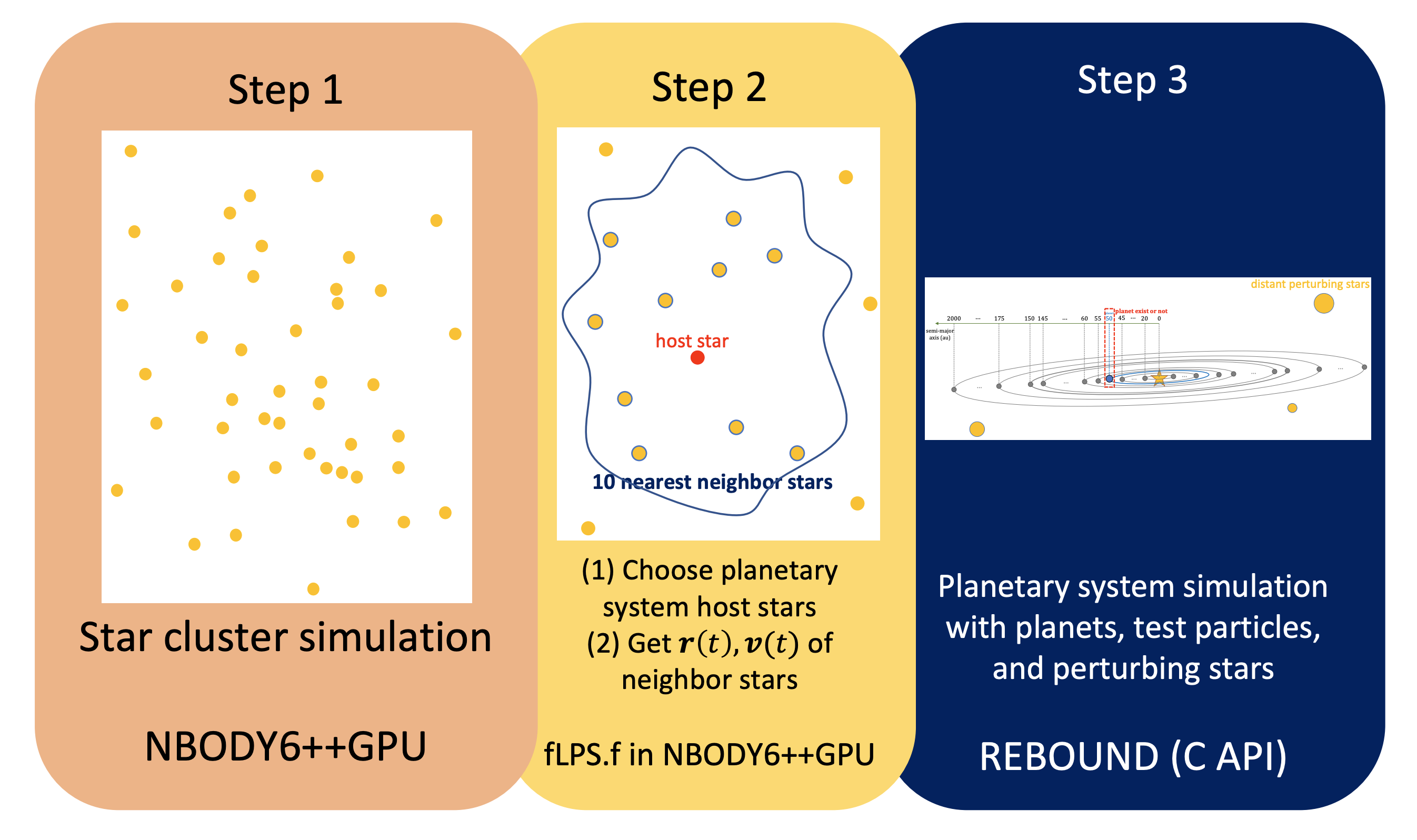
- This work presents numerical simulations of planetary systems in star clusters with different initial stellar densities, to investigate the impact of the density on debris disc dynamics. They use LPS+ to combine N-body codes NBODY6++GPU and REBOUND for simulations. They simulate debris discs with and without a Jupiter-mass planet at 50 au, in star clusters with 𝑁 = 1k - 64k stars.
9-6
Probing the propeller regime with wide neutron star binaries
- Most studies focus on X-ray NS binaries that are sufficiently close so approximation of the evolution and accretion process can be applied. While in this work widely separated binaries are studied in their propeller stage. They found that the propeller stage can have various range of duration depends on the binary parameters. This work is interesting as
Gaianow is able to detect tens of candidates of wide NS binaries with solar-like companions.
9-9
Gravitational wave ringdown analysis using the F-statistic
- This paper discuss an alternative approach to the ringdown analysis using F-statistic instead of traditional time domain (TD) method, which conserves the parameter space irrespective of the number of modes incorporated. It has been shown that it's better than TD method in Einstein Telescope range of ringdown.
9-30
Truncated Moment Formalism for Radiation Hydrodynamics in Numerical Relativity
A truncated moment formalism for general relativistic radiation hydrodynamics, based on the Thorne's moment formalism, is derived. The fluid rest frame is chosen to be the fiducial frame for defining the radiation moments. Then, zeroth-, first-, and second-rank radiation moments are defined from the distribution function with a physically reasonable assumption for it in the optically thin and thick limits.
In Thorne's moment formalism, he defined an unprojected moment of massless particles associated with a moving medium as
\[ M_{(\nu)}^{\alpha_1 \alpha_2 \cdots \alpha_k}\left(x^\beta\right)=\int \frac{f\left(p^{\prime \alpha}, x^\beta\right) \delta\left(\nu-\nu^{\prime}\right)}{\nu^{\prime k-2}} p^{\prime \alpha_1} p^{\prime \alpha_2} \cdots p^{\prime \alpha_k} d V_p^{\prime} \]
where \(f\) is the distribution function of the relevant radiation, \(\nu^{\prime}=-u_\mu p^{\prime \mu}\) the frequency of the radiation in the rest-frame of the medium (i.e, in the rest-frame of the fiducial observer) with \(u^\mu\) being medium's four velocity, \(p^\mu\) the four-momentum of the radiation, and \(d V_p\) the invariant integration element on the light cone. \(k\), here, is positive integer, \(1,2, \cdots\). As pointed out by Thorne, the choice of the fiducial observer is crucial when deriving a good truncated formalism from his moment formalism. In the following, the fluid, coupled with the radiation, is chosen as the medium. Namely, the frequency, \(\nu\), in \(M_{(\nu)}^{\alpha_1 \alpha_2 \cdots \alpha_k}\) always denote the frequency measured in the rest-frame of the fluid.
October
10-31
A New Class of Three Nucleon Forces and their Implications
- This paper describes a new contribution from loop computation of the three-nucleon forces (3NF) calculated using effective field theory (EFT). EFT theory organizes the operators involving nucleon and pion fields in a momentum expansion in which higher-order terms are suppressed by powers of ( \(p / \Lambda_B\) or \(m_\pi / \Lambda_B\) ), where \(p\) is the typical momentum scale of the considered process, \(m_\pi\) is the pion mass, and \(\Lambda_B\) is the breakdown scale associated with the EFT. The numerical value of the coefficients of the operators in the expansion, called the Low Energy Constants (LECs), are fixed by matching to experiments. A particularly attractive feature of the EFT approach to nuclear interactions is that it includes many-body forces naturally and organizes them in a useful hierarchy that is consistent with the momentum expansion of the two-nucleon force (2NF\()\). The contribution of the new 3NFs are large enough to warrant their inclusion in all aspects of nuclear structure studies and calculations of the dense matter EOS.
November
11-1
Masking equation of state effects in binary neutron star mergers
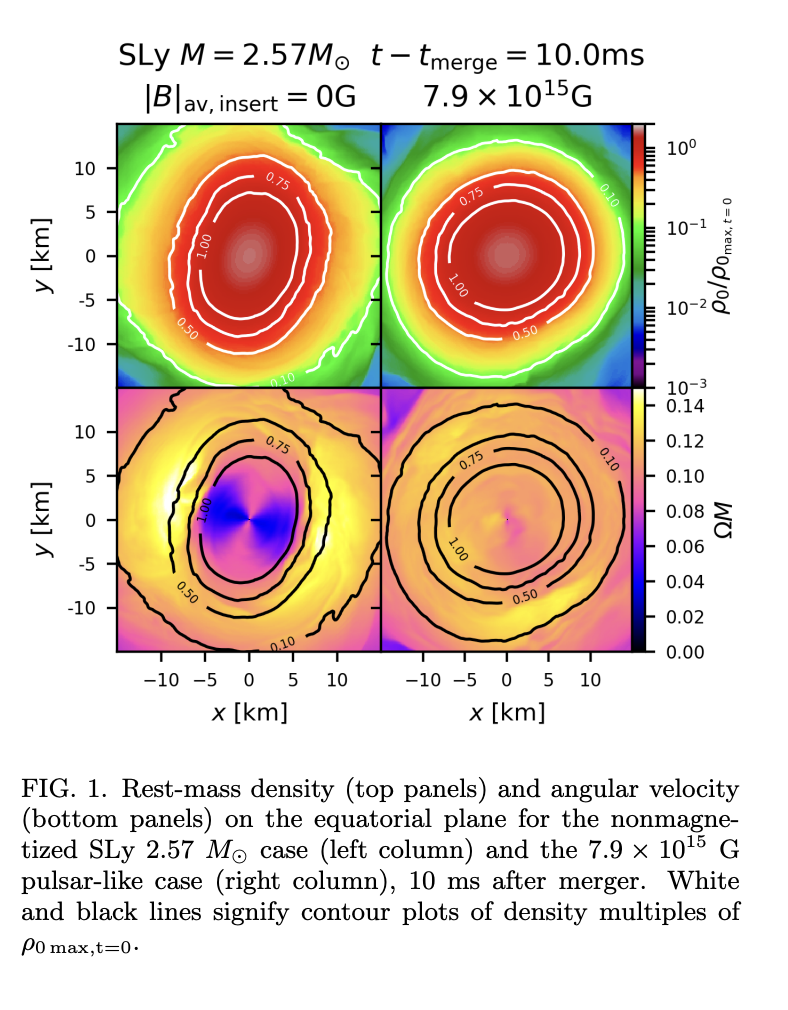
- The paper investigates how magnetic fields in binary neutron star mergers can influence the gravitational wave frequency shifts, potentially masking the effects of the equation of state (EOS). This complicates the interpretation of gravitational wave data, suggesting that a comprehensive analysis must consider magnetic field effects.
- The study focuses on frequency \(f_2\) in the gravitational wave spectrum, which is sensitive to EOS changes. Magnetized cases exhibit higher frequency shifts compared to nonmagnetized cases. Frequency shifts due to magnetic fields can overlap with those from phase transitions or other EOS features, complicating data interpretation.
- Magnetized remnants show different angular velocity profiles and more axisymmetric shapes compared to nonmagnetized ones.
11-28
Accurate muonic interactions in neutron-star mergers and impact on heavy-element nucleosynthesis
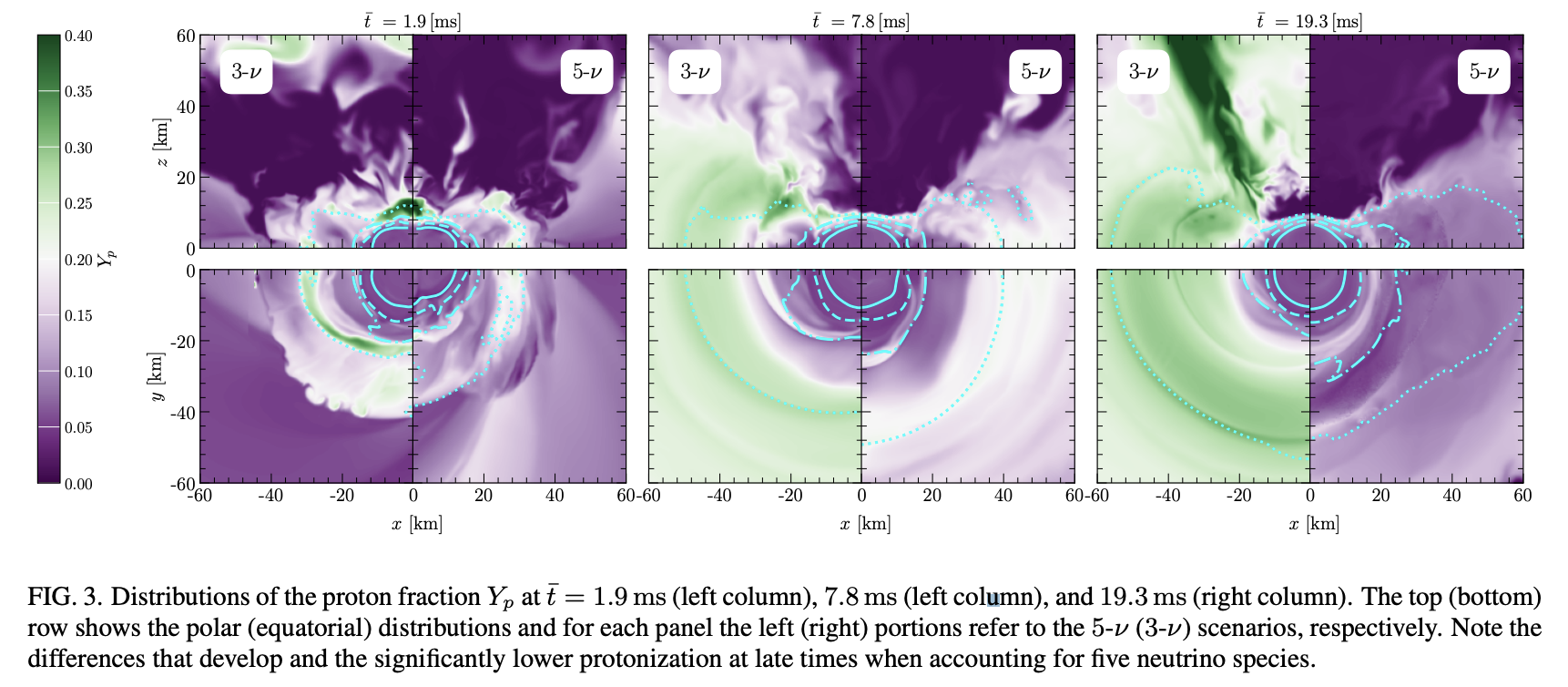
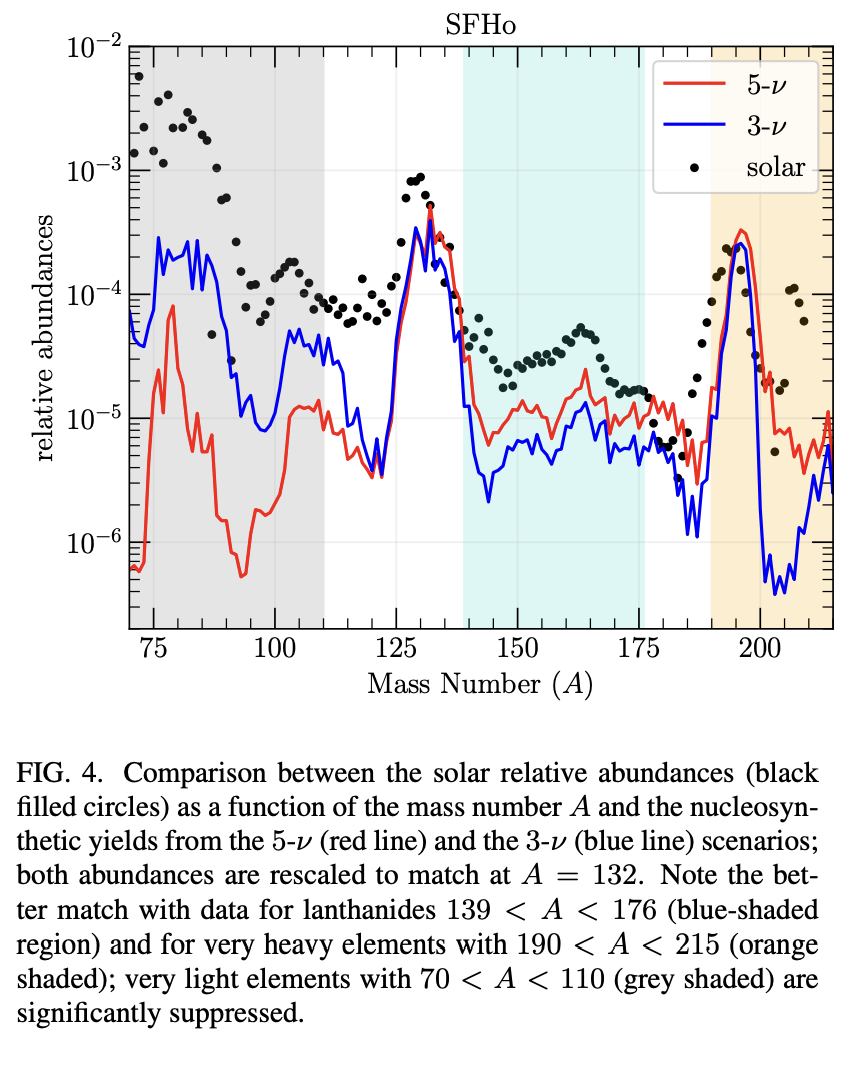
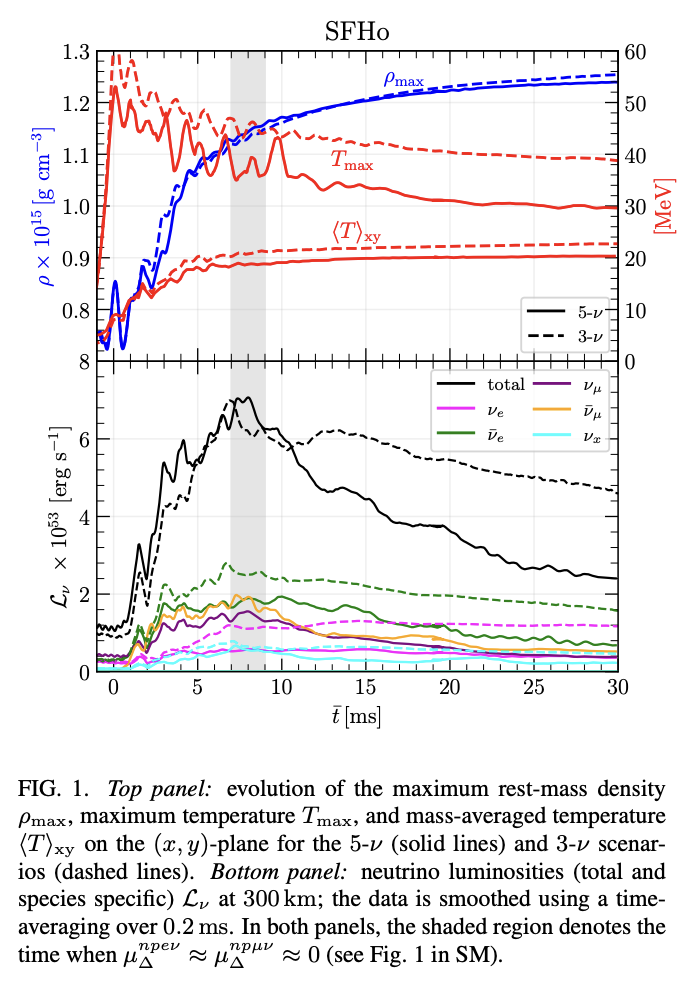
This is the first comprehensive BNS merger simulations with five neutrino species that includes (anti)muons and advanced muonic β-processes. They found muonic interactions significantly impact merger dynamics and nucleosynthesis with two realistic temperature-dependent EOSs: SFHo and DD2.
FIndings:
- 5-ν scenario exhibits stronger cooling due to additional muonic processes
- Muonization occurs in shocked, dense, high-temperature regions
- De-muonization in ejecta leads to less proton-rich dynamical ejecta
- Significant increase in lanthanide yields (~100% for SFHo EOS)
- Suppression of elements with mass number 70 < A < 110